Why Is My Refrigerator Water Dispenser So Slow?
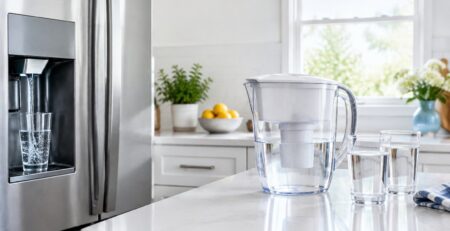
If your fridge takes ages to fill a glass, the water filter is the first thing to check. An aging filter is the most common cause of a slow refrigerator water dispenser, because the sediment it traps gradually narrows the path water has to squeeze through. If the filter is new, trapped air, a cartridge that isn’t fully seated, or low pressure coming into the fridge are the next suspects.
Slow flow rarely happens overnight. It usually creeps up over weeks, until one day you notice you’re standing at the door far longer than you used to. That gradual pattern is a useful clue, and so is the timing of your last filter change.
This guide covers water that still comes out, just weakly. A dispenser that gives nothing at all has a different set of causes.
Time Your Flow Before You Change Anything
A quick measurement turns “it feels slow” into something you can compare. Grab a measuring cup and your phone’s stopwatch.
- Hold the cup under the dispenser and press the paddle.
- Time how long it takes to fill one cup.
- Write the number down.
Repeat the test after each fix below. If the time drops, you know that step worked. Your owner’s manual may list the expected flow rate for your model, which gives you a target to aim for.
While you’re at it, notice how the water comes out. A smooth but thin stream points to a restriction somewhere in the line. Spitting, sputtering and uneven bursts usually mean air.
An Aging Filter Is the Usual Culprit
Every refrigerator water filter has a rated capacity, usually around six months or a set number of gallons, whichever comes first. As it gets close to that limit, the media inside fills with the particles it has caught, and flow drops steadily.
Some homes wear filters out faster than others:
- Large households that drink a lot of dispenser water and use plenty of ice
- Homes with sediment in the water, such as well water or areas with frequent main repairs
- Kitchens where the ice maker runs constantly in summer
If your current filter has been in longer than you can remember, assume it’s done. Our guide on how often to replace your refrigerator water filter explains what shortens a filter’s life. Slow flow often shows up alongside other signs your refrigerator water filter is failing, such as a change in taste or smaller ice cubes.
Can You Clean a Slow Filter?
No. The particles are trapped inside the media, not on the surface, so rinsing the cartridge won’t bring the flow back. A clogged filter has to be replaced.
Swap It and Retest
Install a fresh cartridge that matches your fridge’s filter number, flush it, and run your timing test again. If your fill time is back to normal, the old filter was the restriction.
A new filter is usually the cheapest fix on this list. Our refrigerator water filter range includes genuine OEM and certified compatible cartridges for the major brands, and multipacks lower the cost per filter so the next change is already in the drawer. Shipping is free.
Slow Right After a New Filter? Look at Air and Seating
It’s frustrating when the flow gets worse straight after a filter change, but the cause is nearly always simple.
Push the Air Out
A new cartridge is full of air, and so is the line it connects to. Until that air is pushed out, the water spurts and sputters and seems weak.
- Put a pitcher or large bowl under the dispenser.
- Press the paddle for several seconds, then release, and repeat in short bursts.
- Keep going until the stream runs smooth with no spitting.
- Discard the first batch or two of ice, since it may have been made while air was in the line.
Many filters list how much water to run through after installation, often a few gallons, so check the instructions that came with yours. Cloudy water during the flush is usually tiny air bubbles and clears on its own.
Make Sure the Cartridge Is Fully Home
A filter that’s a few degrees short of locked can let some water through while partially blocking the path. Take it out and reinstall it, turning or pushing until it stops firmly. On push-in styles, listen for the click.
If it still won’t seat properly, compare the part number on the new filter with the one you removed. A near match from a different filter family can sit in the housing without opening fully.
Check the Pressure Coming Into the Fridge
When a new, well-seated filter doesn’t help, the restriction may be upstream of the fridge.
Compare With Your Kitchen Faucet
Turn on the cold tap at the sink. If it’s weak too, the problem is your home’s water pressure, not the refrigerator. Your installation guide lists the pressure range your model needs, and a plumber can test it with a simple gauge.
Is the Valve Only Partly Open?
A shutoff valve that’s half closed will still let water through, just not much of it. Find the valve feeding the fridge, usually under the sink, behind the unit or in the basement, and open it all the way. Older saddle valves, the kind that clamp onto a pipe, are known for clogging and narrowing over time. If yours is stiff, crusty or dripping, ask a plumber to replace it.
Check the Line for a Partial Kink
Gently pull the fridge out and look at the supply tubing. A soft bend that’s flattened but not fully closed is a classic cause of weak flow. Smooth it out and leave a gentle loop of slack when you push the fridge back.
Reverse Osmosis and Whole-House Filters
If your fridge is fed from an under-sink reverse osmosis system or a whole-house filter, those systems lower the pressure reaching the fridge, and they lose more as their own cartridges load up. Changing or servicing those filters often brings the dispenser back up to speed.
When the Slowdown Is Inside the Fridge
If the filter, pressure and supply line all check out, two less common causes remain.
A door line that’s starting to freeze can narrow the flow before it blocks it completely. If the first few seconds are weak and then the stream improves, or your freezer is set colder than the manual suggests, raise the temperature a little and see if things improve over a day.
The water inlet valve at the back of the fridge has a small screen that catches debris. Over time, sediment can clog it or the valve can stop opening fully. Testing and replacing the valve involves household wiring and pressurized water, so book an appliance technician for that one.
Frequently Asked Questions
Why is my water slow but my ice maker works fine?
The ice maker fills a little at a time between cycles, so it can keep working even when flow is reduced. The dispenser shows the restriction straight away because you’re waiting on it. A filter near the end of its life is the usual cause.
Does a slow dispenser mean the filter isn’t cleaning the water?
Not necessarily. Slow flow means the filter is full of what it has caught. It’s a sign the cartridge has done its job and is ready for retirement.
Will an OEM filter flow faster than a compatible one?
Flow depends on fit and condition more than brand. A certified compatible filter made for your exact model should flow well when it’s new and fully seated. If one filter flows noticeably worse than another, check that it’s the correct part number.
Why did the flow slow down after we moved the fridge?
Moving a fridge often kinks or stretches the supply line, and the shutoff valve sometimes gets turned during the move. Check both before anything else.
Find the Filter That Gets Your Flow Back
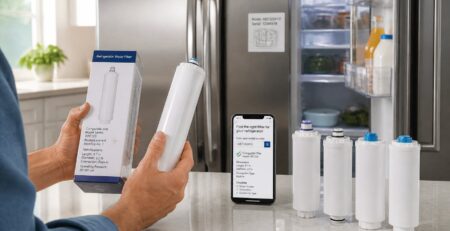
A fresh filter that fits your fridge is the quickest way back to a fast-filling glass. Enter your fridge or filter number in our Cross Reference Filter Tool to see your options, or contact our team with your model number and we’ll match it for you. Your order ships free.