How to Replace Bosch Refrigerator Water Filter: Model-Aware Steps
You open the dispenser, fill a glass, and the water tastes a little flat. Or the filter symbol on the display has been glowing for a week. Knowing how to replace Bosch refrigerator water filter cartridges starts with one fact: Bosch refrigerators do not all use the same filter, and they do not all hide it in the same spot.
The right approach is to look up your refrigerator’s full model number (E-Nr), match it to the correct cartridge, and then follow the twist-in or push-in steps and flushing amount your own manual gives. This order matters because a cartridge that looks close can still fail to lock, drip at the seal, or never filter at all. It also keeps you from paying for a part you cannot use.
With your model number in hand, you can choose between a genuine Bosch filter and a compatible one. You can also swap it out without tools and flush it the way your manufacturer recommends. You will also know what to do if the indicator stays on, the flow slows, or the ice tastes odd for a day or two.
Which Filter Fits Your Bosch Refrigerator?
Your refrigerator’s full model number decides which filter fits, and the old cartridge’s label is your backup clue. Bosch water filter models change between refrigerator lines and even between production runs of the same line. Guessing from a photo or from a friend’s fridge is the most common way people end up with the wrong part.
Read the E-Nr on the Rating Plate
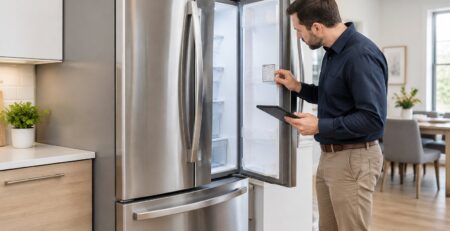
Bosch calls the model number the E-Nr. It is printed on the rating plate, which usually sits inside the fresh food compartment along a side wall or near the crisper drawers. The exact spot varies by appliance type.
Copy the whole number, including the slash and the two digits after it. Bosch gives T24IF905SP/04 as an example of a full E-Nr, and its water filter finder needs all of it to return the right result. The “/04” part is easy to skip, but it can point to a different production version.
Next, check the cartridge already in your fridge. Most filters carry a part number printed on the body or on a sticker. Write down:
- The full E-Nr from the rating plate
- The part number on the old filter
- Whether the filter twists or pushes out (you will confirm this during removal)
- Where the filter sits: inside the fridge, behind the base grille, or on the water line
If the label is worn or missing, the E-Nr alone is enough to start a search.
Confirm Cartridge Fit Before Choosing an OEM or Compatible Filter
A genuine Bosch water filter is built for your model’s housing, so fit is rarely a question once the E-Nr matches. Genuine Bosch replacement filters also cost more, and that is where compatible options come in. A compatible filter can work well, but only if the maker lists your exact Bosch part or model.
You can run your old part number through a filter cross-reference tool to see which cartridges match it, then confirm your model appears on the product page.
Watch out for lookalikes from other brands. An EveryDrop Filter 1 (EDR1RXD1) or a W10295370A cartridge is made for Whirlpool-family refrigerators. A GE XWF filter fits certain GE models. None of these belong in a Bosch unless your model is specifically listed.
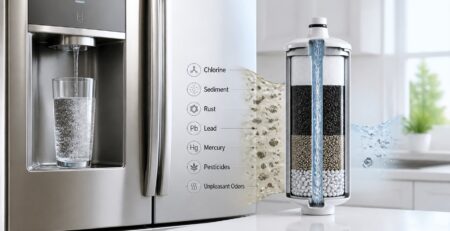
Check certifications on the exact product, too. NSF/ANSI 42 covers taste and odor issues such as chlorine. NSF/ANSI 53 covers certain health-related contaminants, and NSF/ANSI 401 covers some emerging contaminants. A WQA Gold Seal means the Water Quality Association (WQA) certified the product to a standard, so look for which standard and which contaminants are listed.
Where Is the Filter, and What Should You Prepare?
Your filter sits in one of three places: inside the fresh food section, behind the base grille, or on the water supply line behind the fridge. Your manual confirms which one applies. Five minutes of prep saves you from a puddle on the floor.
Check the Interior, Base Grille, or Water Line
Start inside the refrigerator. Twist-in filters often sit in the upper right corner of the fresh food section, while push-in filters usually hide behind a small door or cover inside the compartment. On some units, you open a flap and see the end of the cartridge right away.
If you find nothing inside, check the base grille at the bottom front of the fridge. Some twist-in cartridges sit there, behind a removable panel or cap.
A third setup uses an inline filter on the water line behind the refrigerator. This is more common in older installs or custom setups. If your Bosch is built in, reaching the back may not be practical, so check the manual before you pull anything out.
The manual for each model spells this out. For example, the owner’s manual for the Bosch B20CS30SNS has its own water filter section, a separate page on the water filter symbol, and a performance data sheet for the filter.
Gather the Replacement, a Towel, and Your Model’s Instructions
You do not need tools for most Bosch filter changes. Gather these before you start:
- The correct replacement cartridge, still sealed
- A dry towel or two to catch drips
- A large pitcher or bucket for flushing water
- A container or bag for the used filter
- Your owner’s manual, printed or open on your phone
Keep the new filter’s protective caps on until you are ready to install it. Clear the shelf or drawer in front of the housing so you can reach it straight on. If you keep a stock of filters, store the extras at room temperature in a dry spot.
Remove the Old Cartridge and Install the New One
Removal and installation depend on whether your cartridge twists or pushes into place. Both take only a few minutes. Stop using the dispenser before you begin so water is not moving through the lines.
How to Replace Bosch Refrigerator Water Filter: Twist-In Cartridge Steps
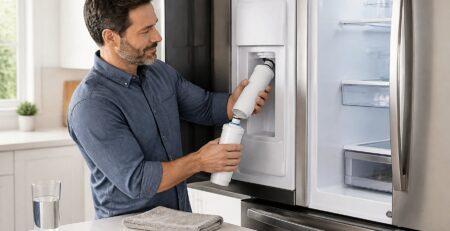
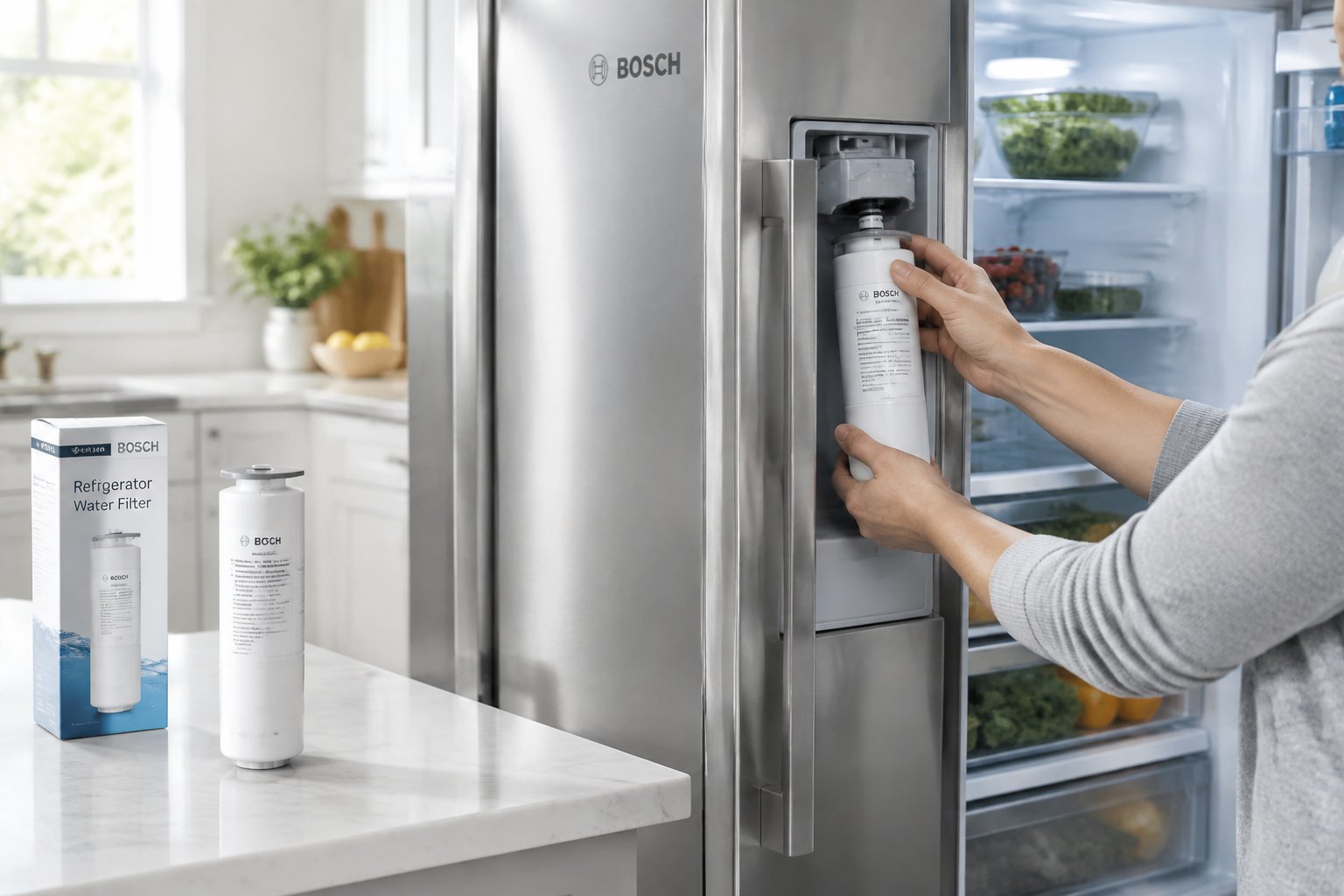
For a twist-in style, here is how to replace Bosch refrigerator water filter cartridges step by step:
- Open the filter cover or remove the base grille cap.
- Hold a towel under the housing.
- Turn the old filter counterclockwise until it releases.
- Pull the cartridge out slowly and keep it level so trapped water stays inside.
- Wipe the housing dry and look for debris or cracks.
- Remove the caps from the new filter and check that its O-rings are in place.
- Line up the arrow or tabs on the new filter with the housing.
- Push it in and turn clockwise until it stops firmly. Do not force it past that point.
A small amount of water will drip out. That is normal and is why the towel is there.
Release and Install a Push-In Cartridge
Push-in filters click into place instead of turning. The release method varies by model, so follow the diagram in your manual.
- Open the small door or cover over the filter.
- Release the filter the way your manual shows.
- Pull the cartridge straight out once it frees itself.
- Wipe the opening dry.
- Uncap the new filter and slide it straight in.
- Push until you hear or feel a click.
If your model uses a push-in style you have not seen before, check the manual’s diagram first. Pulling hard on a locked cartridge can damage the housing.
Check the Seal and Secure the New Filter
A new filter is secure when it sits flush and does not wiggle or back out. Give a twist-in cartridge a light tug; it should not move. A push-in cartridge should stay put without you holding it.
Look at the O-rings one more time if the filter seemed hard to seat. A rolled or pinched O-ring is a common cause of drips. Close the cover or grille, and toss the old filter in household trash, since most filters mix materials that curbside recycling will not accept.
Flush the Water and Check the Replacement
A new filter needs flushing before you drink from it, and the amount depends on your refrigerator’s instructions. Flushing pushes out trapped air and loose carbon dust from the new media.
Use Your Manual’s Flush Amount
Use the flushing amount in the manual for your exact model. Bosch’s general guidance is not the same on every page it publishes, so your model’s manual is the figure to trust. If you have lost the manual, look it up by your full E-Nr.
Dispense in short bursts into a large pitcher, and pour the water on houseplants or down the sink. The first water may sputter or look cloudy. That clears as the air works out.
Reset the Water Filter Symbol
If your Bosch has a filter symbol on the display, reset it after the new cartridge is in. Otherwise the reminder keeps counting from the old filter. The button or button combination differs by model, and the manual lists the exact steps under the water filter symbol section.
Some units have no indicator at all. In that case, write the install date on a piece of tape near the housing so you know when six months are up.
Check for Leaks, Weak Flow, and Ice Maker Issues
Check the housing and the floor under the fridge after an hour, and again the next day. A dry towel under a base-grille filter makes drips easy to spot.
- Leaks: Remove the filter, reseat the O-rings, and reinstall until it locks.
- Weak flow: Keep flushing; trapped air slows flow at first. If it stays weak, the filter may not be fully seated.
- Sputtering: Normal for the first few minutes of dispensing.
- Odd ice: Throw out the first bin of ice and let the ice maker refill.
If flow stays weak after a full flush and a reseat, call Bosch support at 1-800-944-2904.
A Correct Fit and Flush Complete the Filter Change
A Bosch filter change goes smoothly when the cartridge matches your full E-Nr and you flush it the way your manual says. The swap itself takes a few minutes. Most problems afterward, like drips or weak flow, trace back to a filter that is not fully seated or has not been flushed enough.
If your home has more than one refrigerator, keep a note of each model’s filter number. Filters for other brands are a different shape. Regular changes also bring the benefits of a refrigerator water filter, like better-tasting water and ice.
When you are ready, shop Bosch refrigerator water filters at FilterForFridge.com, with free shipping in the lower 48 states. Not sure about fit? Send us your E-Nr by email or call +1 615-758-6915 before you order, and the team will confirm the match.
Frequently Asked Questions
Does a Bosch Filter Change Require Shutting Off the Water Supply?
Most refrigerators do not require you to shut off the household water supply for a filter change. Stop dispensing before you start and keep a towel handy for drips. Check your manual, since a few setups, such as inline filters, can be different.
What if a Bosch Filter Is Stuck in the Housing?
The filter may be a push-in style with its own release method, or a twist-in style that needs a firmer counterclockwise turn. Old O-rings can also stick after months in place. Check your manual’s diagram before pulling hard, and call Bosch support if the housing seems stuck.
How Do I Reset the Filter Light on My Bosch Refrigerator?
You reset it from the control panel, and the steps differ by model. Look for the water filter symbol section in your manual. Many owners find the steps by searching the manual for “reset.”
Should I Throw Out the Ice After a Bosch Filter Change?
Yes, the first ice after a change can hold air bubbles or carbon dust from the new filter. Bosch recommends throwing out one full bin of ice after installing a new cartridge. Ice should look and taste normal once the bin refills.
How Can I Find the Right Filter for a Bosch 800 Series Refrigerator?
Use the full E-Nr on the rating plate, including the slash and last two digits, since 800 Series models do not all share one filter. Match that number, or the part number on your old cartridge, to a listed replacement. You can also send both numbers to a support team for a fit check.