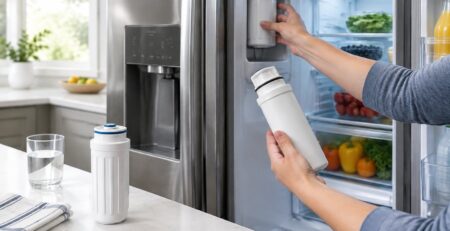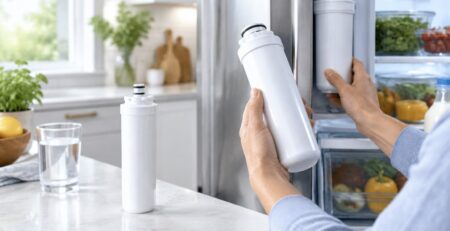
How to Find the Right Refrigerator Water Filter Without Buying the Wrong One
You are standing in front of an open fridge door with the old filter in your hand, squinting at a smudged part number. The light on the control panel has been red for two weeks. The water tastes like a swimming pool. Somewhere in a drawer is a manual you have not opened since the day the appliance was delivered. None of the numbers you can read seem to match anything you find online.
That moment is where most wrong purchases happen. Buyers grab a filter that looks close enough. Then they discover the locking tabs do not turn, or the seal leaks, or the certification list is shorter than they expected.
A certified compatible filter can cost roughly 40% less than the original brand version. That saving only holds if it actually fits and if the contaminant claims are backed by real testing from a group like NSF International or the Water Quality Association (WQA).
In this guide, you will find a step-by-step method for finding the right refrigerator water filter without guessing. You will learn where model numbers hide, how to read fit and connection details, and what NSF/ANSI 42, NSF/ANSI 53, and NSF/ANSI 401 actually cover.
You will also learn how to decide between original equipment manufacturer (OEM) and compatible options. The goal is simple: spend ten minutes now so you spend almost no time on this again.
Start With Your Refrigerator and Filter Model Numbers
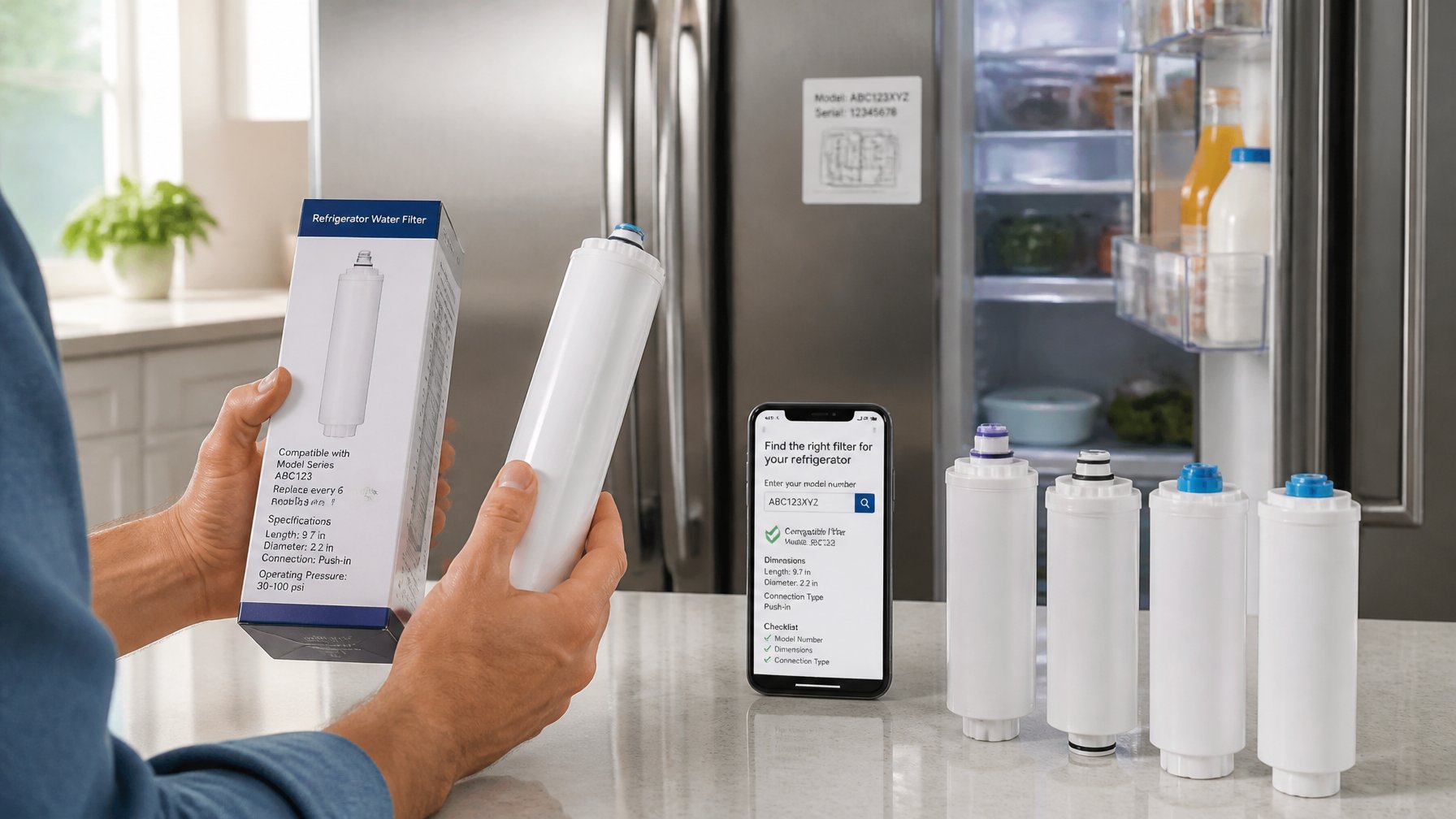
Everything starts with two numbers: your refrigerator model number and the part number of the filter currently installed. Get both, and matching becomes a lookup instead of a guess.
The refrigerator model number is a long string like WRS325SDHZ or LFXS26973S. It identifies the exact unit, including the year and configuration. The filter part number is shorter, something like EDR1RXD1, MWF, UKF8001, or LT1000P. Manufacturers reuse filter numbers across many refrigerator models. One filter number often covers dozens of appliances.
Write both numbers down before you shop. If your fridge has a second filter for the ice maker, note that separately. An ice filter is often a different part from the main drinking water cartridge.
Check the Door Jamb, Interior Wall, or Back Panel
The refrigerator model number lives on a sticker or metal plate. Open the door and look in these spots, in this order:
- The door jamb along the left or right side of the fresh food compartment
- The interior wall near the top of the fresh food compartment, above the shelves
- The ceiling of the fresh food compartment, near the light housing
- Inside the crisper drawer opening or behind the bottom drawer
- The back panel of the unit, near the bottom, if the interior sticker is worn off
Take a photo with your phone rather than copying the number by hand. Model numbers mix letters and digits that are easy to misread. A zero and a letter O look nearly identical on a faded label.
Read the Part Number on the Existing Filter
Pull the old filter out and read the printing on the body of the cartridge. Whirlpool and Kenmore filters usually say Filter 1, Filter 2, Filter 3, or Filter 4, with a matching code such as W10295370A for Filter 1. GE filters print MWF, MSWF, or XWF directly on the cap.
LG cartridges print LT1000P or LT700P on the side, with the older LT500P using a different threaded body entirely. Maytag and some Whirlpool side-by-side units use UKF8001, printed near the top of the cartridge.
If the printing has worn off but the shape is intact, keep the old filter. Its size, cap style, and locking tab pattern become your reference when comparing listings.
Use the Owner’s Manual When the Filter Label Is Missing
No readable label on the cartridge? The owner’s manual lists the filter part number in the maintenance or water system section, usually within the first twenty pages. Most manufacturers post the same manual as a free PDF searchable by refrigerator model number.
If the manual is gone too, a cross-reference filter tool lets you enter the appliance model number and see which cartridges fit it. This is the fastest path for a filter for an older refrigerator model where the original packaging disappeared years ago.
Once you have a part number in hand, the next question is whether the replacement you found will physically lock into your filter housing.
Match the Replacement to the Correct Fit and Connection
A matching part number gets you most of the way there. Fit is what decides whether water flows or drips onto your floor. Filter housings vary in depth, thread pattern, and locking style even within the same brand.
Two filters can share the same diameter and still fail. The LT1000P uses a push-and-twist design in a bottom drawer housing. The LT700P mounts in the upper right of the fresh food compartment with a different cap. Swapping one for the other does not work, no matter how close the numbers look.
Water pressure matters too. Most refrigerator water filters are rated for a supply line pressure between 30 and 120 pounds per square inch (psi). Below that range, the dispenser slows to a trickle and the ice maker underfills.
How to Find the Right Refrigerator Water Filter by Model Number
Searching for a refrigerator water filter by model number is the most reliable method because it removes brand guesswork. Enter the appliance model, such as GSS25GSHSS or WRF535SWHZ. The results show every cartridge rated for that unit.
If you only have the old filter number, search for that instead. A compatible fridge filter lookup for MWF, for example, returns both the OEM GE MWF and certified alternatives such as the Icepure RFC0600A, which runs about 40% less than the original.
A good filter finder should show the fit type, the certifications, and the pack size on the same page. If a listing skips the certification detail, treat that as a reason to keep looking.
Compare Filter Shape, Locking Tabs, and Seals
Line the new cartridge up next to the old one before installing. Check these four points:
- Overall length and diameter, measured from cap to tip
- Cap style, whether it uses a quarter-turn twist, a push-in latch, or a grille-mounted knob
- Locking tab count and position on the collar
- O-ring seals, which should be present, evenly seated, and slightly greasy to the touch
A missing or dry O-ring is the most common cause of a leak after a swap. Whirlpool EDR1RXD1 cartridges use two seals near the head. Both need to be intact.
Know the Difference Between Internal and Inline Filters
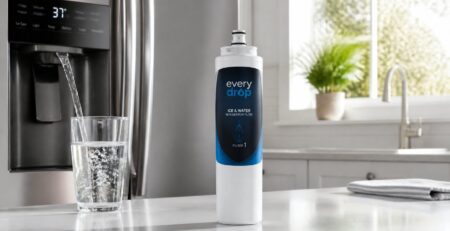
Internal filters sit inside the refrigerator, in the fresh food compartment or the base grille. These are the cartridges most homeowners replace, including EveryDrop Filter 1 EDR1RXD1 and the GE XWF.
Inline filters are installed on the water supply line behind or under the appliance. Older refrigerators without an internal housing rely on them. They connect with quarter-inch compression or push fittings.
If your fridge has both, replace both on the same schedule. An old inline filter can restrict flow enough to make a brand-new internal cartridge look defective.
Check Water Pressure and Water Line Requirements
Low flow after a filter change is usually due to pressure, not the filter. Confirm the shutoff valve under the sink or behind the fridge is fully open. Check that the supply tubing is not kinked behind the unit.
Homes on well systems sometimes sit near the bottom of the 30 psi minimum. A pressure gauge on an outdoor spigot costs about $12 and tells you in a minute whether the fridge is getting enough.
Fit and flow settled. The harder question is what the filter actually removes from the water once it starts working.
Confirm Filtration Claims Before You Buy
A filter that fits perfectly can still do less than you assume. The only way to know what a cartridge removes is to read its certification list, standard by standard.
NSF International writes the public health standards that most water filters are tested against. According to guidance on choosing a home water filter, checking the NSF certification on the label is the practical way to learn what a product actually reduces.
Certification is product-specific, not brand-wide. One cartridge in a manufacturer’s lineup may carry three standards while another carries only one.
What NSF/ANSI 42 Covers for Taste and Odor
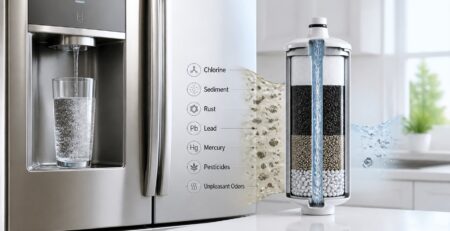
NSF/ANSI 42 covers aesthetic effects: chlorine taste and odor, particulates, and some sediment. It is the baseline standard on nearly every refrigerator cartridge sold in the United States.
This is the standard responsible for the change most people notice first. Water stops tasting like a pool, and ice stops picking up a chemical smell.
NSF/ANSI 42 says nothing about health contaminants. A filter certified only to Standard 42 has not been tested for lead reduction.
When NSF Certification for Lead and Other Contaminants Matters
NSF/ANSI 53 is the health effects standard. It covers lead, cysts such as Cryptosporidium and Giardia, and specific heavy metals and volatile organic compounds, with each claim listed individually.
If your home has older plumbing or lead service lines, Standard 53 lead reduction is the claim to look for. Sediment filters and basic carbon cartridges without that certification do not address it.
Look at the exact claim wording, not the general standard number. A cartridge can be certified to NSF/ANSI 53 for cyst reduction only and still make no lead claim at all.
Understand the Limits of a Carbon Filter
Almost every refrigerator cartridge uses activated carbon. Carbon works well on chlorine, taste, odor, and certain organic compounds. It does very little against dissolved minerals or salts.
Carbon also does not disinfect. Refrigerator filters are not designed to remove bacteria or viruses from water that is already unsafe.
That is the honest boundary of what a fridge filter does. It shapes the next decision: whether the OEM version or a certified compatible version is the better buy.
Choose Between OEM and Compatible Replacement Filters
OEM filters come from the appliance manufacturer. Compatible filters come from independent makers that build to the same fit and test to the same standards. The deciding factor is documented certification, not the name on the box.
Price is where the two diverge sharply. A single OEM cartridge often runs $50 to $75 at retail. Certified compatible versions frequently start under $30 with free shipping included.
OEM filters are not a bad purchase. They are simply a full-price purchase, and buyers who prefer them can often find discounted OEM refrigerator filters instead of paying store shelf prices.
Compare Price, Fit, and Documented Certifications
Judge aftermarket refrigerator water filter quality on three things: published certification claims, physical fit confirmation, and the price per unit in a multi-pack.
- Certifications listed by number, such as NSF/ANSI 42 or NSF/ANSI 53, not the word certified alone
- Explicit model compatibility, naming the OEM part it replaces
- Per unit price in 2, 3, and 4 packs, where bulk savings usually land between 10% and 25%
- Seal and O-ring detail shown in the product photos
Skip any listing that shows none of these. Counterfeit cartridges are a real problem in this category. The WQA has published a counterfeit refrigerator filter study on the risks of uncertified copies.
Use WQA Approval and NSF Certification as Quality Checks
WQA approval and NSF certification are parallel signals. Both mean an independent lab tested the product against a published standard and verified the manufacturer’s claims.
A certified fridge filter carrying a WQA gold seal alongside NSF/ANSI 42 testing gives you the same evidence trail an OEM cartridge provides. Filters sold through FilterForFridge.com carry WQA quality seals and are marked with ISO 9001 and NSF seals. You can browse the full refrigerator water filter catalog by model number.
You can verify a claim yourself through the WQA-certified product listings before you check out.
Cross-Reference Common Whirlpool, GE, and Maytag Filter Numbers
Cross-referencing is straightforward once you know the OEM number. A Whirlpool refrigerator water filter replacement for Filter 1 shows up as W10295370A EDR1RXD1 in most catalogs.
For Maytag UKF8001, the Icepure RFC0900A and Polar PF8001 serve as certified compatible alternatives. For GE, the MWF pairs with the Icepure RFC0600A. The GE MSWF has its own separate cross-reference.
LG owners replacing an older cartridge can look at the OEM LG LT500P. Samsung owners typically need a Samsung DA29 series filter. Kenmore and Frigidaire follow the same pattern with their own part codes.
Once you know which certified option fits, the next step is matching those certifications to what is actually in your tap water.
Match Filter Performance to Your Household Water Concerns
Your local water decides which certifications matter to you. A household on chlorinated city water has different priorities. One drawing from a private well will have its own concerns.
Start with your utility’s annual water quality report. Public systems must send these every year. It lists what has been detected and at what level. This turns filter shopping into a targeted decision.
Well owners should test yearly. Refrigerator cartridges are not built for untreated well water with bacteria present.
Know Which Certifications May Address VOCs, Pesticides, and Pharmaceuticals
Volatile organic compounds (VOCs) fall under NSF/ANSI 53 when a filter carries that specific claim. Chloroform is the common surrogate contaminant used in that testing.
NSF/ANSI 401 is the emerging contaminants standard. It covers substances like pharmaceuticals, certain pesticides, herbicides, and chemicals such as ibuprofen, naproxen, and bisphenol A.
Not every refrigerator cartridge carries Standard 401. If pharmaceuticals or pesticides are your concern, look for that number printed in the certification list. Do not rely on implied marketing text.
Understand Why Fluoride May Require Reverse Osmosis
Fluoride is not reduced meaningfully by a standard carbon refrigerator filter. The molecule is small and dissolved. It passes straight through.
Reverse osmosis systems, tested under NSF/ANSI 58, are the common household option for reducing fluoride along with contaminants like arsenic and nitrate. Those systems are installed under the sink. They do not go in the fridge door.
Keep in mind that fluoride is added to public water to prevent cavities. Removing it is a household choice rather than a safety fix.
Replace the Filter Every Six Months or After 300 Gallons
Replace your refrigerator water filter every six months or after 300 gallons of use, whichever comes first. Certification claims are only valid within that rated capacity.
Past that point, the carbon bed loads up, and contaminant reduction drops off. A saturated cartridge can also slow dispenser flow enough that people mistake it for a plumbing problem.
Some indicator lights track water volume. Others simply count months. Either way, the calendar is the safer trigger. This raises the question of how to make the next replacement painless.
Make the Next Replacement Easier
The install itself takes about five minutes. The habits you set today decide whether the next round takes five minutes or another lost afternoon.
Turn off the ice maker before you start. Have a towel ready. The housing holds a small amount of water even after the line depressurizes.
Most modern cartridges need no shutoff valve at all. Older inline setups on the water supply line do require one. Close the valve first if your filter sits behind the unit.
Install, Flush, and Check for Leaks
Follow this order every time:
- Twist or push the old cartridge out and set it on the towel
- Remove protective caps from the new filter and check bothO-ringss
- Insert and turn until the tab locks. Usually, a quarter turn is enough.
- Run 2 to 4 gallons through the dispenser to flush carbon fines
- Reset the filter indicator light. Then run the ice maker for one full cycle and discard it.
Watch the housing for the first hour. A slow drip almost always means the cartridge is not fully seated or an O-ring rolled during insertion.
Cloudy water in the first few glasses is trapped air, not a defect. It clears within a gallon or two.
Save Your Filter Number and Set a Six-Month Reminder
Write the filter part number on a piece of masking tape and stick it inside the fridge door. Photograph it too, so it lives in your phone as well as the appliance.
Add a recurring calendar event six months out. Optional six-month replacement reminder emails work the same way. Nothing ships automatically unless you place an order.
Buying a 22- or 4-pack now means the next replacement is already sitting in the closet at a lower per-unit price.
Get Expert Model Matching and Free Shipping When You Are Ready
If the numbers still do not line up, hand the problem to someone else. Email your refrigerator model number or old filter part number and get a match back at no cost.
You can also call (615) 758-6915 with the cartridge in your hand and read the printing aloud. Filters not currently listed in the catalog can usually be located on request.
Every order ships free. This leaves one last set of questions most homeowners ask before they check out.
Frequently Asked Questions
Where Can I Find My Refrigerator’s Water Filter Model Number?
Check the printing on the cartridge itself first. Then look at the door jamb sticker, the interior wall of the fresh food compartment, or the back panel. The owner’s manual lists it in the water system section. Photograph the label rather than copying it by hand. Zeros and letter Os look nearly identical on worn stickers.
How Do I Identify the Correct Replacement Filter for a Whirlpool Refrigerator?
Whirlpool cartridges are labeled Filter 1, Filter 2, Filter 3, or Filter 4, with matching codes such as W10295370A or EDR1RXD1 for Filter 1. Read the label on the old cartridge. Then confirm the appliance model number against the listing. A cross-reference tool will show every compatible option for that Whirlpool model.
What Water Filter Does My Samsung Refrigerator Need?
Most Samsung refrigerators use a DA29 series cartridge. DA29-00020B and DA29-00003G are the two most common. The part number is printed on the filter body and repeated in the owner’s manual. Confirm it against your appliance model number. Samsung uses different housings across French door and side-by-side units.
Can I Use a Compatible Replacement Filter Instead of the OEM Refrigerator Filter?
Yes, as long as the compatible cartridge lists the same fit and carries documented certification such as NSF/ANSI 42 or WQA approval. Certified alternatives like the Icepure RFC0600A for GE MWF cost roughly 40% less than the original. The certification list, not the brand name, is what confirms performance.
How Can I Tell Whether a Refrigerator Water Filter Is NSF 42, NSF 53, or NSF 401 Certified?
The standard numbers are printed on the cartridge body, the packaging, and the product listing. NSF/ANSI 42 covers chlorine taste and odor. NSF/ANSI 53 covers lead and cysts. NSF/ANSI 401 covers pharmaceuticals and pesticides. You can verify any claim through the NSF- or WQA-certified product databases before buying.
Are EveryDrop Filter 1, Filter 4, and Filter A Interchangeable?
No. EveryDrop Filter 1 (EDR1RXD1), Filter 4, and Filter A use different housings, cap styles, and locking patterns. They are not substitutes for each other, so match the number printed on your old cartridge or listed in your refrigerator’s manual before ordering.