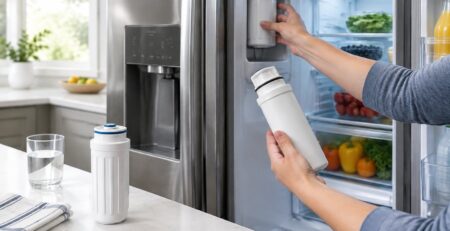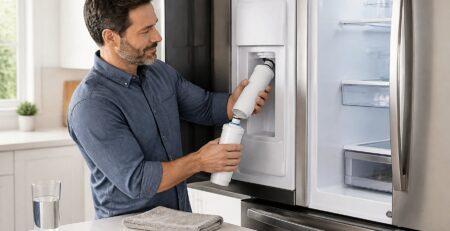
Discontinued Refrigerator Water Filter Replacement: Find a Certified Match
You pull the old cartridge out of the fridge, type the number into a search bar, and get the same answer everywhere: no longer available. Maybe the listing says “discontinued.” Maybe the manufacturer replaced the part with something that has a completely different name. Your refrigerator still works fine. The water dispenser still runs. The only thing missing is a filter that fits.
This happens constantly with older refrigerators, especially units built between 2005 and 2015. Manufacturers retire filter lines, rename part numbers, or roll several old cartridges into one newer model. A discontinued fridge filter almost never means your refrigerator is obsolete. It usually means the part number changed hands. You need a cross-reference to find the current certified match.
In this guide, you will find a clear path to a discontinued refrigerator water filter replacement, from a dead part number to a working cartridge. Keep reading to learn how to locate your old filter number and how to cross-reference it to a compatible cartridge.
You will also see what NSF and Water Quality Association (WQA) certifications actually prove, and how to install and flush the new filter correctly. The point is to solve this once, spend less, and get back to everything else on your list.
Start With the Old Filter Number
Every fix starts with one thing: the part number printed on the filter you already have. That number, not the refrigerator brand, is what unlocks a compatible replacement refrigerator water filter.
Filter part numbers look like UKF8001, DA29-00020B, MWF, ULTRAWF, EDR1RXD1, or W10295370A. They are short, mixed letters and digits, and they appear in more than one place on most refrigerators. Even a discontinued number is useful. Cross-reference charts are built around those retired codes.
If the number is faded or the filter is missing entirely, you still have two backups: the filter housing and the refrigerator model number. Work through them in order.
Check the Label on the Water Filter Cartridge
Pull the old water filter cartridge out and read the label wrapped around the body. On a Whirlpool or EveryDrop cartridge, you will usually see both a marketing name and a technical number, such as Filter 1 and W10295370A. Write down both.
Samsung cartridges print a number near the top collar, often in the format HAF-CIN or DA29-00020B. LG uses codes like LT500P and 5231JA2002A. GE prints MWF, MSWF, GSWF, or XWF right on the cap. Maytag and older Amana units commonly show UKF8001 or UKF8001AXX.
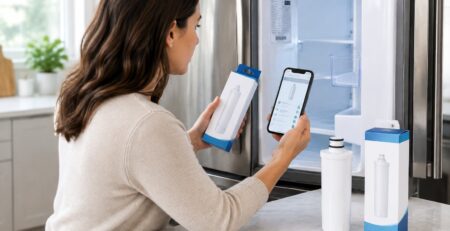
Take a photo of the label before you throw the old cartridge away. If the print has worn off from six months of condensation, tilt the filter under a light and check the molded plastic. Many cartridges have the number stamped into the housing itself.
Look Inside the Refrigerator Compartment and Filter Housing
If the cartridge is gone or unreadable, check the filter housing where it seats. Manufacturers often print the accepted filter model on a sticker beside the intake, on the grille door, or on the inside of the base grille cover.
Common housing locations by style:
- Top right rear of the fresh food compartment: behind a small flip-up door, on many Whirlpool, Maytag, and KitchenAid units
- Base grille below the doors: a push-in or quarter-turn cartridge, on older GE and Frigidaire side-by-sides
- Upper left interior wall: a twist-in cartridge, on many Samsung French door models
- Inside the fresh food door: a slide-out cassette, on some LG and Kenmore Elite models
While the housing is open, look for a bypass plug. Some refrigerators ship with one. If a previous owner left it in place, there may be no filter number to find at all.
Use the Owner’s Manual or Refrigerator Model Number
When the cartridge and housing give you nothing, fall back on the refrigerator model number. It lives on a nameplate inside the fresh food cavity, usually along a side wall or near the door hinge, and sometimes on the door jamb or the back of the unit.
The manual lists the original filter model in the maintenance section, often with a note about accepted alternates. If you no longer have the paper copy, the model number is enough to look up the correct cartridge in any filter finder.
Consumer Reports confirms this same approach in its guidance on how to pick a refrigerator water filter that fits. The nameplate inside the fresh food cavity is the reliable fallback. So you have a number in hand. What do you do when that number returns nothing but dead listings?
Cross-Reference a Compatible Replacement
A dead part number is a starting point, not a dead end. Cross-referencing means taking your retired code and finding the current cartridge built to the same fit and flow specifications.
Most discontinued filters were not eliminated. They were rolled forward. Maytag UKF8001 is a good example: it is still one of the most cross-referenced numbers in the category. Compatible options like Icepure RFC0900A and Polar PF8001 are built to the same dimensions and connection.
Steps for a Discontinued Refrigerator Water Filter Replacement
Work through a discontinued refrigerator water filter replacement in this order:
- Enter the old part number first: exactly as printed, including any suffix like AXX or P.
- Enter your refrigerator model number second if the part number returns nothing.
- Confirm the physical style: twist-in, push-in, or inline, against the photo of the replacement.
- Check the certification listing: looking for NSF 42 at minimum and WQA approval.
- Compare rated capacity, usually 200 gallons or 300 gallons, to your household use.
A cross-reference filter tool handles the first two steps in one search. This saves you from scrolling through outdated forum threads.
Match the Filter Part Number Before the Refrigerator Brand
Brand alone will not get you there. GE Appliances alone produces AFPWF, GSWF, MSWF, MWF, RPWFE, XWF, and XWFE cartridges. None of them are interchangeable across every GE refrigerator.
Kenmore complicates this further. Kenmore refrigerators were built by Whirlpool, LG, Frigidaire, and others, depending on the year. A Kenmore badge tells you almost nothing about the filter inside. The three-digit prefix on the Kenmore model number, 106, 795, or 253, points to the actual manufacturer.
Start with the part number. Use the brand only to confirm you are in the right family.
Confirm the Filter Style and Connection Type
Three physical styles cover almost every household refrigerator. Mixing them up is the most common ordering mistake.
- Twist-in cartridges: rotate a quarter turn into an interior housing. Whirlpool EDR1RXD1 and Samsung DA29-00020B are twist-in.
- Push-in cartridges: slide straight into a base grille and lock with a button. GE MWF and MSWF are push-in.
- Inline filters connect to the water line behind the refrigerator and are not brand-specific at all.
Length and collar diameter matter too. Two cartridges can share a connection style and still refuse to seat if the body is a quarter inch too long.
Examples for Whirlpool, GE, Samsung, and Maytag Models
Whirlpool retired several older numbers into the EveryDrop line. W10295370A and Filter 1 now map to EDR1RXD1, the everydrop Filter 1 replacement. This fits a wide range of Whirlpool, Maytag, KitchenAid, and Amana side-by-side and French door units.
On the GE side, older MWF units cross-reference to Icepure RFC0600A, which runs about 40% less than the original GE MWF. Newer GE fridges moved to the GE XWF refrigerator water filter. Certain Profile and Café models still take the GE MSWF cartridge.
Samsung HAF-CIN and HAF-QIN owners will find current Samsung refrigerator water filters mapped to DA29-00020B and DA97-17376B. LG owners with an older LT500P will find the OEM 5231JA2002A LG LT500P filter alongside compatible options in the LG filter catalog.
You have a compatible part number now. The next thing to confirm is whether that compatible cartridge cleans your water the way the discontinued original did.
Choose Certified Quality Instead of an OEM Label
Certification, not the brand name on the box, is what proves a filter reduces contaminants. A compatible cartridge tested to the same NSF/ANSI standard as the discontinued original performs to that same standard.
That matters more than it sounds. The original equipment manufacturer (OEM) label mostly tells you who sold the filter. The NSF number tells you what the carbon media was actually tested to remove.
What NSF 42, NSF 53, and NSF/ANSI 401 Cover
Each standard tests for a different group of contaminants. A single filter can carry more than one.
- NSF/ANSI 42 covers aesthetic contaminants, such as chlorine taste, odor, and particulates. It also covers material safety, so the cartridge itself does not leach anything into your water.
- NSF/ANSI 53 covers health-related contaminants, including lead, cysts, asbestos, and certain volatile organic compounds (VOCs).
- NSF/ANSI 401 covers emerging contaminants such as trace pharmaceuticals, pesticides, BPA, and microplastics.
- NSF/ANSI 372 confirms the filter is essentially lead-free by construction, at 0.25 percent maximum weighted lead content.
One caution worth knowing: a filter certified to NSF/ANSI 401 does not automatically reduce every contaminant on that list. Some 401-certified cartridges address trace chemicals but make no microplastics claim. Read the published claim list, not just the badge.
How WQA Approval Supports Compatible Filter Selection
The Water Quality Association (WQA) is one of three major bodies that test and list filters against those NSF/ANSI standards. The other two are NSF International and the International Association of Plumbing and Mechanical Officials (IAPMO). A WQA gold seal on a compatible cartridge means an independent lab tested it, not the seller.
This is also your best defense against counterfeits. WQA has documented ongoing problems with fake filters carrying copied logos and forged certification badges. You can verify a real listing through the WQA-certified product listings by product name.
For a discontinued fridge filter, WQA approval is what closes the confidence gap. It confirms that the substitute meets a published standard rather than just fitting the housing.
Compare Published Contaminant Reduction Claims
Before you order, pull up the claim sheet for the replacement and set it next to what the original did. Activated carbon filtration is standard across most refrigerator cartridges. The carbon media density and contact time drive how much each one actually reduces.
Ask three questions. Does it carry NSF/ANSI 42 at minimum? Does it claim NSF/ANSI 53 lead reduction if lead is a concern in your area? Does the rated capacity, 200 gallons or 300 gallons, match how much water your household pulls in six months?
Municipal water quality reports, usually posted on your city’s website, tell you which contaminants are actually present locally. That turns certification shopping into a specific decision instead of a guess. Once the right cartridge arrives, the installation is where most people lose water pressure without realizing why.
Install the New Filter and Restore Water Flow
Installation takes about ten minutes. The flush step matters more than the seating step. Skip the flush and your first few glasses will taste like carbon dust.
Most modern refrigerators shut off water flow automatically when you remove the cartridge, so you rarely need to turn off the supply valve. Older base grille models are the exception. If your fridge takes a push-in GSWF or MWF-style cartridge, keep a towel handy.
Remove the Old Cartridge Without Damaging the Housing
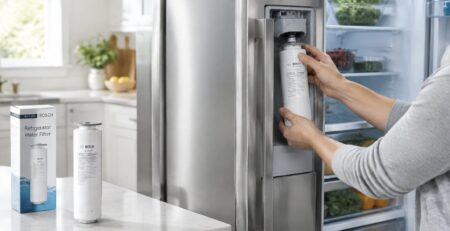
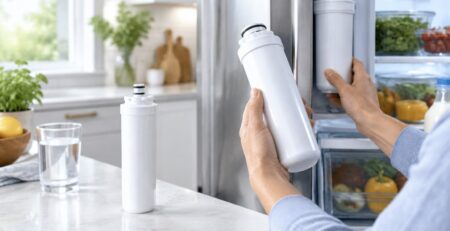
For twist-in cartridges like EDR1RXD1 or DA29-00020B: turn counterclockwise about a quarter turn until the cartridge releases, then pull straight out. Do not force past the stop point. The plastic tabs inside the housing crack easily.
Push-in cartridges in the base grille usually eject when you press the release button beside them. If the cartridge is stuck from mineral buildup, rock it gently side to side instead of yanking. A little water will spill. That is normal.
Look inside the empty housing before installing anything. Debris or a broken O-ring left behind from the old cartridge will cause a leak no matter how well the new filter seats.
Lock the New Filter Into Place and Check for Leaks
Remove the protective caps from the new cartridge and note the alignment arrow or notch on the collar. Line it up, insert, and turn clockwise until it clicks or reaches the lock indicator.
Once seated, run water for five seconds and put your hand under the housing. A drip usually means the cartridge is a quarter turn short of locked, not defective. Back it out and reseat it.
Check behind the refrigerator too if you moved the unit. A kinked supply line will mimic filter failure exactly.
Flush the System Before Using Water or Ice
New activated carbon releases loose particles for the first few gallons. Run 2 to 4 gallons through the water dispenser, in 30-second bursts, until the stream is clear and the sputtering stops.
For ice makers, dump the first two or three full batches. Ice quality lags behind dispenser water because the mold fills slowly and traps early sediment. The Environmental Protection Agency’s guidance on how to install a water filter and change cartridges reinforces flushing as a standard step across filter types.
Reset the Filter Indicator Light
The indicator is a timer or a flow counter, not a sensor. It will keep glowing red until you clear it manually.
- On most Whirlpool and Maytag units, press and hold the Filter or Filter Reset button for three seconds.
- Samsung models typically use Ice Type and Child Lock held together for three seconds.
- LG uses the Filter button held for five seconds.
- GE dispensers usually use the Reset Water Filter held for three seconds.
If the light stays on, the button combination varies by year. The manual lists the exact sequence. With filtered water flowing again, the real question becomes how to avoid repeating this whole search in six months.
Keep Future Replacements Simple and Affordable
The fastest way to avoid another discontinued filter scramble is a fixed replacement rhythm and a saved part number. Once you know your compatible cartridge, the next order is a two-minute task.
Cost adds up quickly here. At $50 per OEM cartridge twice a year, you are spending roughly $100 annually per refrigerator. Certified compatible options starting under $30 cut that closer to $60. Multi-packs push the per-unit price lower still.
Replace Filters Every Six Months or at the Rated Capacity
Replace your refrigerator water filter every six months or at the rated capacity, whichever comes first. Most cartridges are rated for 200 gallons or 300 gallons. A typical family of four hits that mark in about half a year.
Capacity varies by model, so check yours. GE MWF is rated at 300 gallons. Some Samsung and LG cartridges are rated at 200 gallons. This means heavier households may need a swap closer to month four.
Old carbon media does not just stop working. It can hold trapped organic material where bacteria grow. This is why running a filter past its rated life is worse than running no filter at all.
Watch for Slow Flow, Poor Taste, or Cloudy Ice
Your refrigerator tells you when the cartridge is finished, usually before the indicator light does. Watch for these signs:
- Dispenser flow drops below roughly two cups per minute
- Chlorine taste or a musty smell returns to the water
- Ice turns cloudy or picks up freezer odors
- The dispenser sputters even after the line has been purged
- Ice production slows because the restricted filter starves the ice maker
Slow flow is the most reliable signal. A clogged cartridge restricts water long before it stops reducing contaminants. It strains the water filtration system in the process.
Get Model-Matching Help Before You Order
If your old number is discontinued and the cross-reference results look ambiguous, send someone the model number instead of guessing. A quick email or a call to (615) 758-6915 is faster than ordering the wrong cartridge twice.
- Order in two-packs or four-packs so the next replacement is already in the cabinet.
- Sign up for a six-month reminder email so the date never sneaks up on you. Filters are not sent automatically unless you request an order.
- Keep a photo of your cartridge label on your phone. It makes the next order a search instead of a search party.
Your Discontinued Filter Is Not a Dead End
A retired part number is a paperwork problem, not an appliance problem. The old code still works as a cross-reference key. The housing and nameplate give you backups, and NSF 42, NSF 53, and NSF/ANSI 401 certifications tell you exactly what the substitute cartridge removes.
That means you are not stuck choosing between a $50 OEM cartridge and an unverified no-name filter. A WQA-approved compatible replacement built to the same standard as your discontinued original does the same job for roughly 40% less on models like the GE MWF.
Ready to sort it out? Use the filter finder or browse the refrigerator water filter catalog at FilterForFridge.com. You can also email your old part number and refrigerator model, and the team will match it for you at no cost. Certified filters start under $30. Shipping is free on every order.
Frequently Asked Questions
How Do I Find a Compatible Replacement When My Refrigerator Water Filter Model Is Discontinued?
Start with the old part number printed on the cartridge, such as UKF8001 or HAF-CIN, and run it through a cross-reference tool. If the cartridge is gone, use the refrigerator model number from the nameplate inside the fresh food compartment. Most discontinued numbers map directly to a current certified cartridge.
Can I Use a WQA-Approved Aftermarket Filter Instead of a Discontinued OEM Refrigerator Filter?
Yes. A WQA-approved cartridge has been tested by an independent lab against the same NSF/ANSI standards the OEM filter was tested against. Confirm the fit, the connection style, and the published contaminant claims. Then check the listing on the WQA-certified product database.
How Do I Identify the Correct Whirlpool Replacement Filter From My Refrigerator Model Number?
Find the model number on the nameplate inside the fresh food cavity. Then match it to the EveryDrop family. Older Whirlpool numbers like W10295370A and Filter 1 now cross-reference to EDR1RXD1. The maintenance section of the owner’s manual lists the accepted cartridge for your specific unit.
Which Samsung Refrigerator Water Filters Replace Discontinued HAF-CIN and HAF-QIN Models?
HAF-CIN cartridges cross-reference to DA29-00020B. HAF-QIN cartridges cross-reference to DA97-17376B. Both are twist-in cartridges that mount on the upper left interior wall of most Samsung French door refrigerators. Confirm the collar alignment notch matches before ordering.
Are Compatible Refrigerator Filters Tested to NSF 42 or NSF 53 Standards?
Many are. NSF/ANSI 42 covers chlorine taste, odor, and material safety. NSF/ANSI 53 covers health-related contaminants like lead and cysts. Check the published claim list for the specific cartridge, since not every compatible filter carries both certifications.
How Often Should I Replace My Refrigerator Water Filter After Switching to a Compatible Model?
Every six months or at the rated capacity, whichever comes first. Most compatible cartridges are rated for 200 gallons or 300 gallons. This is the same as the OEM version they replace. Heavy water use can shorten that window to four or five months.