NSF-Certified Refrigerator Water Filter Standards: What 42, 53, and 401 Tests
You are looking at two filter listings for the same refrigerator. One says NSF 42. The other says NSF 42, 53, and 401, and costs twelve dollars more. Nothing on either page explains the difference. You are left guessing whether the extra money buys real protection or just extra text on a box.
That guesswork is exactly what NSF-certified refrigerator water filter standards are supposed to remove, once you know what each number means.
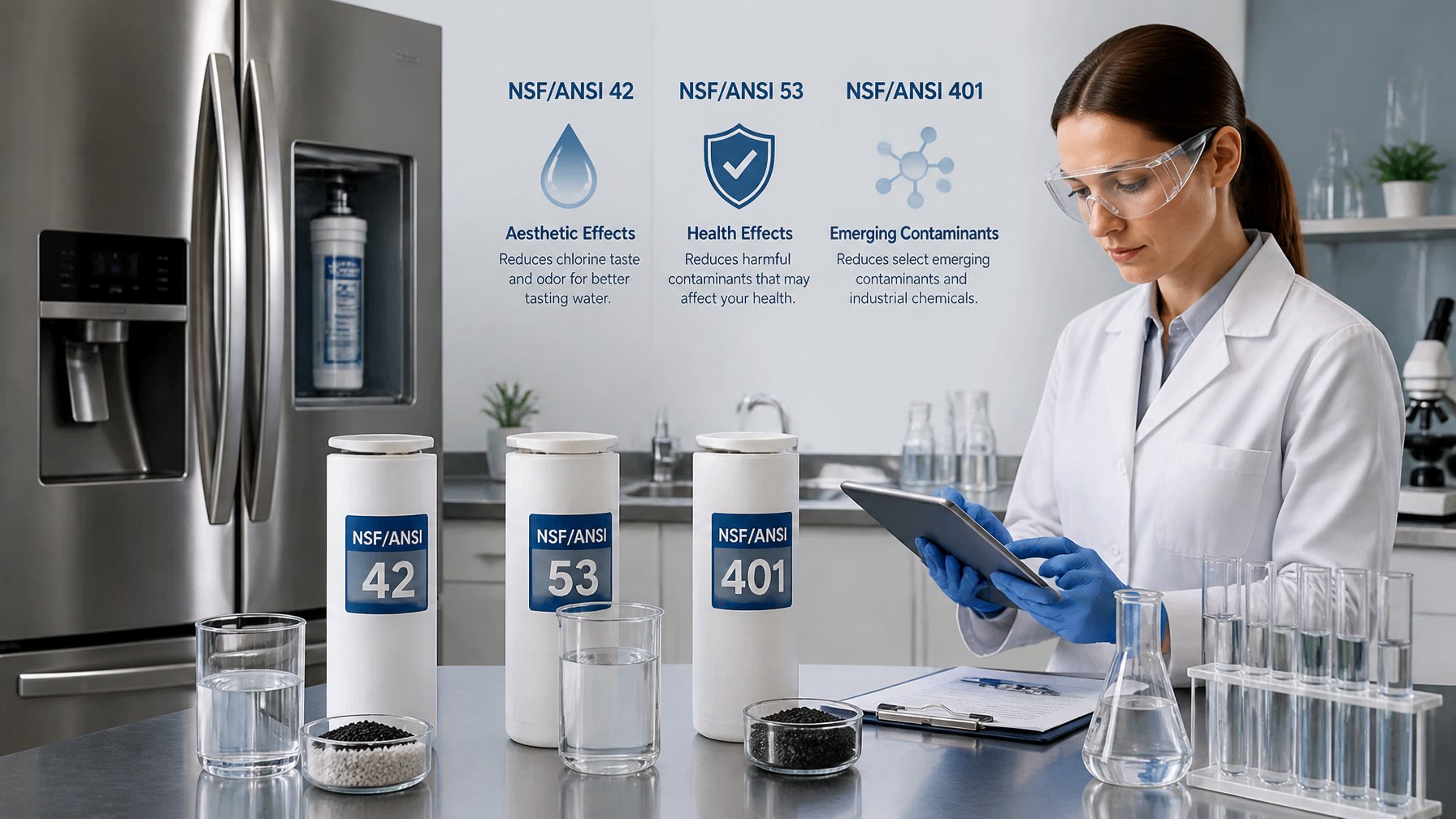
Those three numbers are not a good, better, best ladder. NSF/ANSI 42 covers taste and odor. NSF/ANSI 53 covers health-related contaminants like lead and cysts. NSF/ANSI 401 covers emerging contaminants like certain pharmaceuticals and pesticides.
A single filter can carry all three, one of them, or none. The certification mark alone does not tell you which contaminants were actually tested.
Keep reading to learn how to read a certification label and what each of the three standards tests for. You will also see where the Water Quality Association (WQA) Gold Seal fits in and how to match all of it to your own water and refrigerator model.
The goal is simple: spend ten minutes now so your next filter purchase takes two. You can get back to everything else on your list.
How To Read Certification Labels Before You Buy
A certification mark on a filter box means one thing: an accredited third party tested that product against a published standard. It does not mean the filter removes everything. It does not mean that two filters with the same mark perform identically.
NSF International writes and maintains the standards jointly with the American National Standards Institute (ANSI), which is why you see them written as NSF/ANSI 42 or NSF/ANSI 53.
NSF International also runs its own certification program for drinking water treatment units. Other accredited bodies, including the Water Quality Association, test to the same NSF/ANSI standards.
What NSF Certification Verifies
Certification to an NSF/ANSI standard covers three separate things, not just contaminant removal. Testing looks at material safety, structural integrity, and the accuracy of the claims printed on the package and in the literature.
Material safety matters more than most shoppers realize. The housing, adhesives, and media inside a filter like the Whirlpool EDR1RXD1 all sit in contact with your drinking water for six months. Certification confirms that those materials do not leach harmful amounts of anything back into the water.
Structural testing confirms the cartridge holds up to household line pressure without splitting. Claims review confirms that if the box says lead reduction, a lab actually measured lead reduction at the rated capacity. This is usually 200 to 300 gallons for a refrigerator filter.
Why NSF/ANSI Standard Numbers Are Not Quality Rankings
A filter certified only to NSF/ANSI 53 is not automatically better than one certified only to NSF/ANSI 42. The numbers describe different scopes of testing, not tiers of quality.
Think of them as categories on a menu. NSF/ANSI 42 handles aesthetic effects: things you can taste, smell, or see. NSF/ANSI 53 handles health effects: contaminants with documented health risks. NSF/ANSI 401 handles a defined list of emerging compounds.
Most quality refrigerator filters carry NSF/ANSI 42 at minimum. Better ones add 53. A smaller group adds 401. What matters is whether the certifications on the box line up with what is actually in your tap water.
Why One Certification Does Not Cover Every Contaminant
Even within a single standard, certification is claim by claim. A filter certified to NSF/ANSI 53 for cyst reduction has not necessarily been tested for lead reduction under that same standard.
This trips up a lot of buyers. The mark on the box is the headline. The specific claims live in the performance data sheet and in the certifier’s public listing.
Here is what to check before you trust a claim:
- The standard number, written as NSF/ANSI 42, 53, 58, or 401
- The exact contaminants listed under each standard for that model
- The rated capacity in gallons, commonly 170, 200, or 300 for fridge filters
- The certifying body’s mark, such as NSF International or the WQA Gold Seal
- The model number on the listing matches the model number on the filter you buy
How WQA Approval Compares With NSF Certification
WQA approval and NSF certification are parallel signals, not competing ones. Both organizations are accredited to test drinking water treatment units against the same public NSF/ANSI standards.
The WQA runs the oldest third-party water treatment certification program, known as the Gold Seal. Products earning it are tested for contaminant reduction, material safety, and structural integrity. They are then retested regularly with annual facility inspections.
WQA makes the point directly: the standards are public-domain NSF/ANSI standards. Several accredited bodies can certify them.
So a compatible filter carrying a WQA Gold Seal for NSF/ANSI 42 has met the same written requirement as an OEM filter certified by NSF International to NSF/ANSI 42. The seal differs. The standard does not.
That raises the obvious next question: what does NSF/ANSI 42 actually require a filter to do?
NSF/ANSI 42 For Better Taste And Odor
NSF/ANSI 42 tests a filter’s ability to reduce aesthetic contaminants: the things that make water taste like a swimming pool or look cloudy in the glass. It is the most common certification on refrigerator filters. For most city water customers, it is the one doing the daily work.
The WaterSense guide to home water treatment from the Environmental Protection Agency (EPA) describes NSF/ANSI 42 as the standard covering products that improve taste and odor. Nothing in that standard addresses health risk. That is a separate standard entirely.
What Aesthetic Effects Certification Covers
Aesthetic effects mean qualities you notice with your senses. Under NSF/ANSI 42, the testable claims include chlorine taste and odor reduction, turbidity reduction, particulate reduction, and reduction of iron, zinc, or manganese.
Particulate reduction is graded in classes based on particle size. Class I, the strictest, covers particles from 0.5 to under 1 micron. The EPA notes that a filter certified to NSF/ANSI 42 for Class I particulate reduction removes very small particles that may carry lead. That is not the same as a certified lead reduction claim.
Filters like the GE MSWF and the LG LT500P carry NSF/ANSI 42 claims for chlorine taste and odor. That is the baseline you should expect from any refrigerator filter you buy.
Chlorine And Chloramine Claims To Check
Free chlorine and chloramines are not the same thing. A filter certified for one is not automatically certified for the other. Most public water systems use one or the other as a disinfectant.
Free chlorine reduction is the standard NSF/ANSI 42 claim, and carbon handles it well. Chloramine is chlorine bonded with ammonia. It is more stable, harder to strip out, and requires more contact time with the carbon media.
If your utility switched to chloramine, and many have, check whether your filter model lists chloramine reduction specifically. Your annual water quality report names the disinfectant your system uses.
Why Activated Carbon Is Common In Refrigerator Filters
Almost every refrigerator filter uses activated carbon, usually pressed into a carbon block. Carbon works through adsorption: contaminant molecules stick to the enormous surface area inside the carbon’s pores.
A carbon block filter does two jobs at once. The block structure physically traps particles, which supports turbidity and particulate claims. The carbon itself adsorbs chlorine and organic compounds that cause off-tastes.
The carbon block is also compact enough to fit inside a cartridge the size of the EDR1RXD1 or the GE XWF. That combination of size, cost, and performance is why you rarely see anything else inside a fridge filter.
Taste is one thing. The contaminants you cannot taste are where NSF/ANSI 53 comes in.
NSF/ANSI 53 For Health-Related Contaminant Reduction
NSF/ANSI 53 covers health effects. This is the standard that tests for contaminants with documented health risks. It is the one to look for if lead, cysts, or industrial chemicals concern you.
Testing under NSF/ANSI 53 is stricter than under 42. The filter has to reduce the contaminant below a specific concentration tied to EPA or Health Canada drinking water limits. It has to keep doing it at full rated capacity.
Lead And Heavy Metal Reduction Claims
Lead reduction is the most requested NSF/ANSI 53 claim, and for good reason. Lead usually enters drinking water from service lines and household plumbing, not from the treatment plant. A filter at the point of use is often the practical fix.
The EPA has published guidance for identifying filters certified to reduce lead. It notes that several ANSI-accredited certification bodies test point-of-use filters for lead, and each uses its own registered mark. Certification to NSF/ANSI 53 for lead means the filter reduces both particulate and dissolved lead.
Other heavy metal claims under NSF/ANSI 53 include mercury, copper, chromium, and asbestos. Not every certified filter carries all of them. A filter like the GE XWF may list a different combination than a Samsung DA29-00020B. The model number matters.
Cyst And VOC Claims Explained
Cysts are the hard-shelled stages of parasites, mainly Giardia and Cryptosporidium. They resist chlorine. That is why filtration, rather than disinfection, is the defense. NSF/ANSI 53 cyst reduction requires the filter to remove at least 99.95 percent.
Volatile organic compounds, or VOCs, are a group tested together. Under NSF/ANSI 53, chloroform serves as the surrogate contaminant. If a filter passes for chloroform, it is certified for the full VOC list.
That list includes benzene, MTBE, trihalomethanes, and dozens of solvents and pesticides. It is one of the better values in certification. One claim covers a wide group of chemicals.
Why You Must Check The Exact Contaminant Listing
Two filters can both display an NSF/ANSI 53 mark and reduce completely different things. The mark tells you the standard. The listing tells you the claims.
Check the certifier’s public database or the performance data sheet packed with the filter. Search by the exact model number, not the brand name.
Common NSF/ANSI 53 claims to look for by name:
- Lead, both particulate and dissolved forms
- Cyst, covering Giardia and Cryptosporidium
- VOC, verified using chloroform as the surrogate
- Mercury, copper, and chromium as separate heavy metal claims
- Asbestos, listed independently of other particulate claims
Lead and cysts have been on the radar for decades. Newer to the testing are the compounds that only recently started showing up.
NSF/ANSI 401 For Emerging Contaminants
NSF/ANSI 401 is the newest of the three and covers what the standard calls emerging compounds and incidental contaminants. These are trace substances found in water supplies that are not yet regulated under the Safe Drinking Water Act.
The standard tests a defined list of up to 15 compounds. A filter certified to NSF/ANSI 401 must reduce them by set percentages, typically 95 percent or higher, across the rated filter life.
Which Pharmaceuticals And Chemicals May Be Tested
The NSF/ANSI 401 list mixes several categories. It includes prescription and over-the-counter drugs, pesticides, herbicides, and a few industrial chemicals.
Compounds tested under NSF/ANSI 401 include:
- Pharmaceuticals such as ibuprofen, naproxen, and atenolol
- Hormones including estrone
- Pesticides and herbicides such as linuron and metolachlor
- Chemical byproducts, including bisphenol A (BPA) and nonylphenol
- Insect repellent compounds, specifically DEET
- Flame retardants such as TCEP and TCPP
These show up in surface water at extremely low levels, usually parts per trillion. The WQA has studied consumer awareness of emerging contaminants and found real interest in point-of-use treatment for exactly these compounds.
PFAS Claims Require Model-Specific Verification
PFAS, the per- and polyfluoroalkyl substances often called forever chemicals, are not part of the NSF/ANSI 401 list. This surprises people. It is worth being precise about this.
PFAS reduction, including PFOA and PFOS, is certified under NSF/ANSI 53 or NSF/ANSI 58 for reverse osmosis systems. The WQA states plainly in its guidance on PFAS reduction technologies that shoppers should look for products certified to NSF/ANSI 53 or 58 for PFAS.
So if PFAS is your concern, an NSF/ANSI 401 mark on a refrigerator filter does not answer it. Look for a specific PFOA and PFOS reduction claim listed under NSF/ANSI 53 for your exact model.
What NSF 401 Does Not Promise
NSF/ANSI 401 certification does not mean a filter removes all pharmaceuticals or all pesticides. It means the filter met the reduction targets for the specific compounds tested on that model.
It also does not cover bacteria, viruses, PCBs outside the tested list, or nitrate. Those fall under other standards or are not addressed by carbon filtration at all.
A filter certified to NSF/ANSI 401 is not automatically certified to 53. The two are separate scopes. Most 401 filters do carry 53 as well. Knowing what each standard tests is half the work. The other half is knowing which ones your household actually needs.
Match The Filter To Your Water Concerns And Refrigerator Model
Certifications only help if they line up with what is in your water. Start with your water source. Then work backward to the standard, then to the model number.
If you are on public drinking water, your utility publishes an annual Consumer Confidence Report. It lists detected contaminants and the disinfectant used. Private wells are not covered by the Safe Drinking Water Act. Well owners need independent lab testing.
When A Refrigerator Filter Is Enough
For most homes on treated municipal water, a refrigerator filter certified to NSF/ANSI 42 and 53 handles the realistic concerns. Chlorine taste, cysts, and lead picked up from household plumbing are common issues. A carbon block cartridge addresses all three.
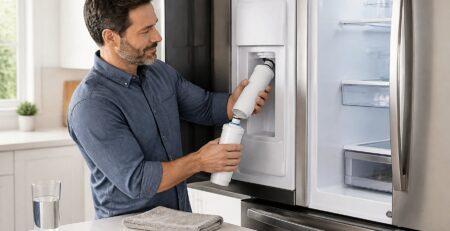
A filter like the EDR1RXD1 for Whirlpool and Kenmore models, or the LG LT500P, covers that range at the point where you actually drink the water. Replacement every six months or 300 gallons keeps the media working as certified.
If your water report shows no exceedances and you are mainly bothered by taste, NSF/ANSI 42 alone may be all you need.
When Reverse Osmosis Or Another System May Fit Better
Some contaminants pass straight through carbon. Total dissolved solids, fluoride, arsenic, nitrate, and nitrite are not reduced meaningfully by a refrigerator filter.
Those call for reverse osmosis, certified under NSF/ANSI 58. An RO membrane rejects dissolved salts and many ions that carbon cannot touch. Consumer Reports notes that when a water quality report shows a wide range of contaminants, reverse osmosis is often the stronger option.
Other standards cover other equipment:
- NSF/ANSI 44 for cation exchange water softeners
- NSF/ANSI 55 for ultraviolet treatment against bacteria and viruses
- NSF/ANSI 58 for reverse osmosis systems
- NSF/ANSI 62 for distillation systems
- NSF/ANSI 177 for shower filters
- NSF/ANSI 244 for supplemental microbiological filtration
Hard water is a softener issue. It is not a fridge filter issue. Confirmed microorganisms in a private well are a UV or RO issue.
Verify The Model Number And Performance Data Sheet
Once you know which standard you need, find your exact filter model. The part number is printed on the old cartridge itself, listed in the owner’s manual, or shown inside the fridge compartment near the filter housing.
Common examples:
- W10295370A, which is the same cartridge as EDR1RXD1
- GE MWF
- GE MSWF
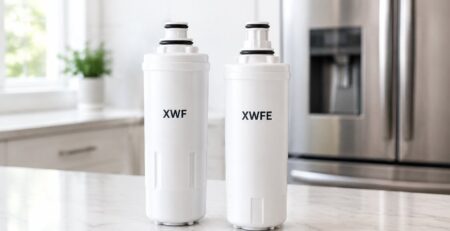
- GE XWF
- Maytag UKF8001
- Samsung DA29-00020B
Cross-reference tools let you enter a refrigerator model number and get the matching filter.
Then read the performance data sheet. It lists every certified claim, the standard number, the certifying body, and the rated capacity. This is the document that settles whether a listing’s certification talk is accurate.
Choose A Certified Compatible Replacement With Confidence
A compatible filter certified to the same standard as the OEM cartridge meets the same written requirements. The Icepure RFC0600A, for example, replaces the GE MWF at roughly 40 percent less than the original.
Consumer Reports has covered how to find a cheaper replacement refrigerator water filter while avoiding counterfeits. The advice comes down to buying from a seller who lists verifiable certification and model matching. That is the difference between a bargain and a gamble.
So how do you turn all of this into a five-minute purchase decision?
Make Your Next Replacement Decision With Clearer Standards
Turn the certification numbers into a short checklist. The buying part gets fast. You already know your water source and your filter model. Now match them.
Use The Certification Number To Narrow Your Choices
Pick the standard that matches your concern. Then filter your options by it. If chlorine taste is the issue, NSF/ANSI 42 is your minimum. If lead or cysts are the issue, insist on NSF/ANSI 53 with those specific claims listed.
If you want coverage for trace pharmaceuticals or pesticides, look for NSF/ANSI 401 on top of 42 and 53. Expect to pay a few dollars more for the added scope. Confirm the compounds are named on the data sheet.
Whether the mark comes from NSF International or is a WQA Gold Seal, the underlying NSF/ANSI standard is identical. Both are accredited third-party programs with ongoing retesting.
Find An Affordable Filter By Model Number
The fastest path is searching by your existing part number. Enter W10295370A, GE XWF, MSWF, LT500P, UKF8001, or DA29-00020B, and the compatible options come up with their certifications listed.
A cross-reference filter tool matches your refrigerator model to the right cartridge if you cannot find the old part number. From there, you can compare a discounted OEM filter against a certified compatible one and decide based on the claims, not the logo.
Buying two or four packs lowers the per-unit cost further. This helps if you manage more than one refrigerator or want the next replacement already in the cabinet. Six-month reminders keep the schedule from slipping.
Which brings it back to the thing that started all this: knowing exactly what you are paying for.
Buy By Standard, Not By Sticker Price
The certification numbers are the shortcut. NSF/ANSI 42 for taste and odor, NSF/ANSI 53 for lead, cysts, and VOCs, NSF/ANSI 401 for emerging compounds. Read the performance data sheet, confirm the specific claims, and the marketing language on the box stops mattering.
A compatible cartridge certified to the same NSF/ANSI standard as the OEM version meets the same tested requirements. That is why a WQA-approved, NSF-certified replacement can cost 40 percent less than the name brand without asking you to accept less protection.
When your six months are up, browse the refrigerator water filter catalog at FilterForFridge.com by model number. Or email your model number, and the team will match it for you at no charge. Filters start under $30 with free shipping on every order. The only thing left to decide is how many packs you want on hand.
Frequently Asked Questions
What Does NSF 42 Certification Cover in a Refrigerator Water Filter?
NSF/ANSI 42 covers aesthetic effects, meaning chlorine taste and odor, turbidity, particulates, and metals like iron and zinc that affect taste or appearance. It does not test for health-related contaminants. Most refrigerator filters, including the GE MSWF and LG LT500P, carry this certification as a baseline.
What Contaminants Does NSF 53 Certification Reduce From Refrigerator Water?
NSF/ANSI 53 covers health effects and can include lead, mercury, copper, chromium, asbestos, cysts such as Giardia and Cryptosporidium, and volatile organic compounds. Claims are model-specific. A filter certified to NSF/ANSI 53 for cysts may not be certified for lead. Always check the exact contaminant list on the performance data sheet.
Do Refrigerator Filters With NSF 401 Certification Reduce Emerging Contaminants?
NSF/ANSI 401 tests the reduction of up to 15 named compounds, including ibuprofen, naproxen, atenolol, DEET, BPA, and certain pesticides and herbicides. It does not cover PFAS, which are certified under NSF/ANSI 53 or NSF/ANSI 58 instead. The certification applies only to the compounds tested on that specific model.
How Can I Verify That a Replacement Refrigerator Water Filter Is NSF-Certified?
Search the certifying body’s public product listing using the exact filter model number, such as W10295370A, GE XWF, or DA29-00020B. Then read the performance data sheet, which names the standard, the certifying body, the specific claims, and the rated capacity in gallons. If a listing shows a certification mark but no claim details, treat that as incomplete.
Is a WQA-Approved Compatible Refrigerator Filter Safe To Use Instead of an OEM Filter?
Yes, when the compatible filter is certified to the same NSF/ANSI standard and the same claims as the OEM cartridge. The Water Quality Association is an accredited third party that tests drinking water treatment units to the same public NSF/ANSI standards. The seal differs from an NSF International mark. The standard being met is identical.
Which NSF Certification Should I Look For To Reduce Lead, Chlorine Taste, and Odor?
Look for a filter certified to both NSF/ANSI 42 and NSF/ANSI 53. Chlorine taste and odor should be listed under 42. Lead reduction should be listed under 53. One mark alone will not cover both concerns. Certification to NSF/ANSI 53 for lead covers both particulate and dissolved lead.