Contaminants Refrigerator Water Filter Should Remove: 5 NSF-Tested Risks
You are standing in front of the fridge with a filter cartridge in your hand, and the box lists a wall of claims. Chlorine taste. Lead. Cysts. Some numbers you have never seen before. You want to know one thing: does this thing actually do what it says?
That question matters more than the price on the shelf. Two filters can look identical, cost $25 apart, and reduce completely different things. The gap between them is not the plastic housing. It is whether an independent lab tested the cartridge and certified it to a published standard. Without that testing, a claim on a box is just printing.
Keep reading to learn the five contaminants a refrigerator water filter should remove and which NSF standard covers each one. You will also see why those standards separate a real filter from a cheap shell. You will also see how certified compatible cartridges stack up against original manufacturer parts on price. The goal is simple: spend ten minutes here, then stop thinking about your fridge filter for another six months.
Read NSF Ratings Before Comparing Filter Prices
Price tells you almost nothing about what a filter removes. The certification listing does. Before you compare a $19 cartridge to a $55 one, check which NSF/ANSI standards each is certified against.
NSF International is an independent organization that writes public health standards for products, including drinking water treatment units. The Water Quality Association (WQA) is a second accredited body that tests and certifies the same products. Both put a seal on the box only after lab testing confirms the performance claims.
The CDC recommends looking up the exact product in a certification database rather than trusting label wording. It notes in its guidance on how to choose a home water filter that different filters do very different jobs.
Why These Five Contaminants Make the List
The five contaminants covered in this guide are not a random list. They are the ones most often tested and certified for refrigerator cartridges. They are also the ones that show up in tap-sourced household water.
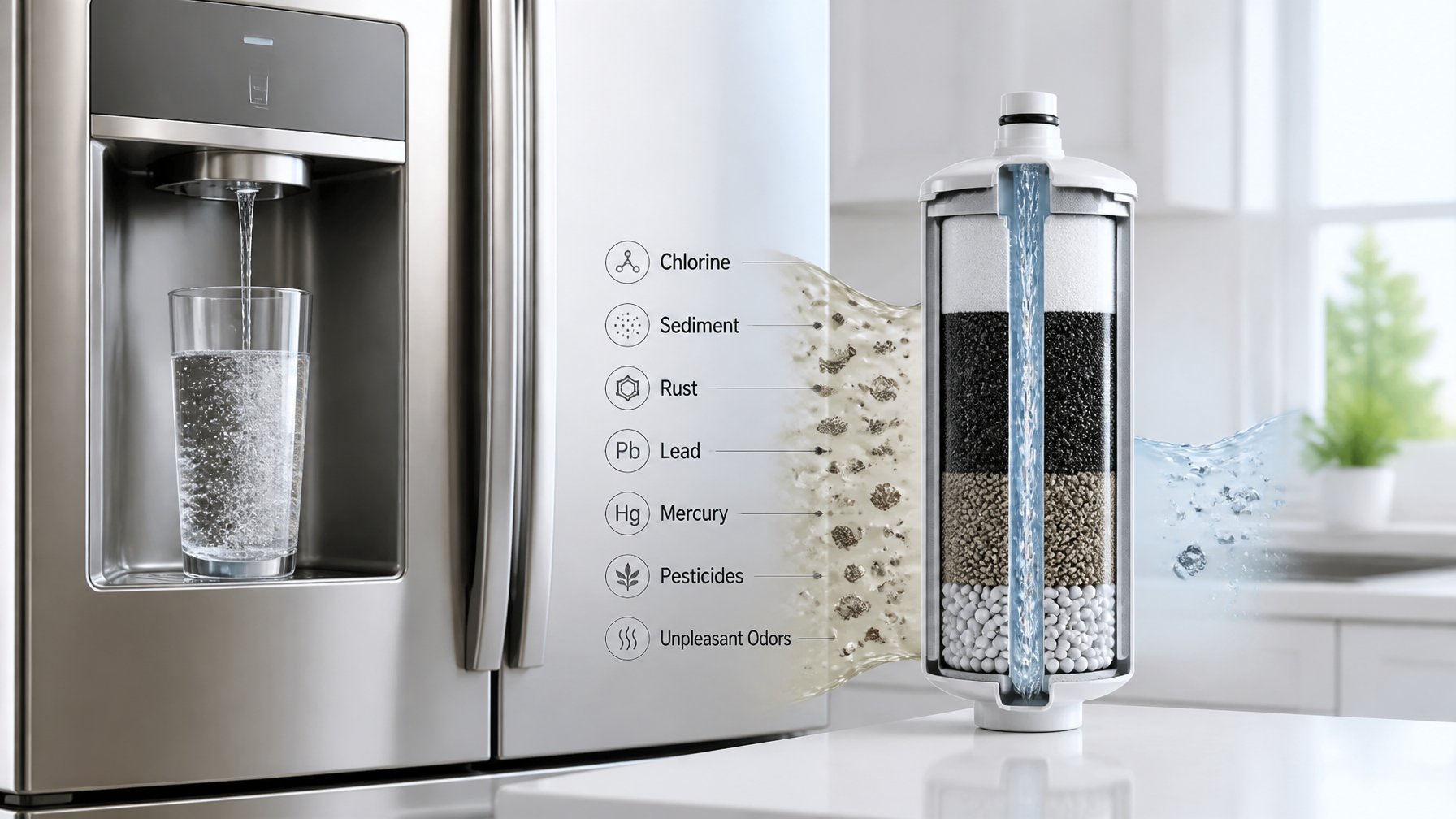
Here is what a fridge water filter is commonly certified to reduce:
- Chlorine taste and odor under NSF/ANSI 42
- Lead under NSF/ANSI 53
- Mercury under NSF/ANSI 53
- Cysts such as Cryptosporidium and Giardia under NSF/ANSI 53
- Benzene, a Class I volatile organic compound (VOC), under NSF/ANSI 53
Four of those five are health-related contaminants. Only chlorine sits in the aesthetic category. That is the one most people notice first.
Each one maps to a specific NSF standard.
What NSF/ANSI 42 Covers for Taste and Odor
NSF/ANSI Standard 42 covers aesthetic effects. That means taste, odor, color, and visible particles. Chlorine reduction is the headline claim under this standard, along with particulate reduction rated by class.
A filter certified only to NSF/ANSI 42 will make your water taste better. It is not tested for lead or cysts. That is a real distinction, not a technicality. It explains why two similar-looking cartridges can carry very different price tags.
What NSF/ANSI 53 Covers for Health-Related Contaminants
NSF/ANSI Standard 53 covers health effects. Lead, mercury, cyst reduction, asbestos, and specific volatile organic compounds all fall under this standard.
Certification under NSF/ANSI 53 is contaminant-specific. A cartridge can be certified for lead and cysts but not for mercury. Always read the claim list, not just the standard number on the front of the box.
Why WQA Approval and NSF Certification Matter for Compatible Filters
A compatible filter is not automatically a lesser filter. A WQA-approved, NSF-certified compatible cartridge has passed the same performance testing as an original equipment manufacturer (OEM) part.
The risk is not compatibility. They are uncertified counterfeits. The WQA and appliance manufacturers have flagged this as a real market problem in their work on counterfeit refrigerator filters. An uncertified cartridge may pass water through and reduce nothing.
That is the standards side. What does it look like in your glass? Let’s start with the contaminant you can actually taste.
Start With Chlorine for Better-Tasting Water and Ice
Chlorine is the reason your ice smells like a swimming pool. It is also the first contaminant most homeowners notice. NSF/ANSI 42 is built to address this.
Municipal water systems add chlorine on purpose. It kills bacteria and viruses on the trip from the treatment plant to your kitchen. That protection matters. The CDC supports water disinfection with chlorine and chloramine as a public health practice.
By the time the water reaches your fridge, the disinfection job is done. Removing the leftover chlorine taste at the point of use does not make your water less safe.
Chlorine Reduction Under NSF/ANSI 42
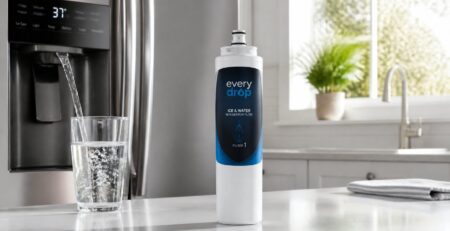
Chlorine taste and odor reduction is the most common certified claim on refrigerator filters. Cartridges like the EveryDrop Filter 1 EDR1RXD1 and the GE MSWF both carry chlorine reduction claims tested under NSF/ANSI 42.
If a filter lists no NSF standard at all, assume nothing has been verified. Wording like “improves taste” carries no testing behind it on its own.
How Activated Carbon Improves Water Taste
Almost every fridge cartridge uses activated carbon. The carbon is packed as a solid block or as loose granules. Water passes through it under line pressure.
Chlorine molecules stick to the carbon surface through a process called adsorption. The carbon has an enormous internal surface area. That is why a small cartridge can treat 200 to 300 gallons before it loses effectiveness.
Once the carbon surface fills up, taste comes back. That is your first sign that the cartridge is spent. It usually arrives around the six-month mark.
Chlorine is the contaminant you can taste. The next risks hide from your senses completely.
Look for Lead and Mercury Reduction Where Plumbing Is a Concern
Lead and mercury are both heavy metals, both certified under NSF/ANSI 53, and both invisible in your glass. You will never taste them. That is exactly why the certification matters.
Lead is the bigger concern for most households, and it rarely comes from the water source. According to the CDC, lead in drinking water most often comes from lead pipes, brass faucets, and solder inside the home.
That means two houses on the same municipal line can have very different lead levels at the tap.
Lead Reduction Under NSF/ANSI 53
Lead reduction under NSF/ANSI 53 is a specifically tested claim. The lab runs challenge water at a set pH and concentration through the cartridge and measures what comes out at the end of the rated life.
Homes most likely to benefit from a lead-certified cartridge include:
- Houses built before 1986, when lead solder was still legal
- Homes served by a lead or galvanized service line
- Older buildings with original brass fixtures
- Any address where the utility has flagged a lead status as an unknown line
The EPA’s consumer tool for identifying filters certified to reduce lead covers refrigerator cartridges directly and walks through how to verify a claim.
Mercury Reduction Under NSF/ANSI 53
Mercury is less common in household tap water than lead. It is a separate NSF/ANSI 53 claim with its own test protocol. A filter certified for lead is not automatically certified for mercury.
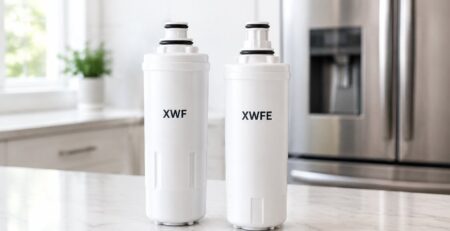
Cartridges such as the GE XWF and the LG LT500P (5231JA2002A) list their certified reduction claims individually. Read the list rather than assuming coverage.
Metals dissolve in water. The next two risks behave completely differently.
Confirm Protection From Cysts and Benzene
Cysts are living parasites large enough to be strained out. Benzene is a chemical small enough to slip through most screens. Both are covered under NSF/ANSI 53. They use two very different mechanisms inside the same cartridge.
This is where filter design gets interesting. A carbon block that removes benzene by adsorption also acts as a physical barrier tight enough to catch cysts.
Cyst Reduction for Cryptosporidium and Giardia Under NSF/ANSI 53
Cryptosporidium and Giardia are microscopic parasites that cause stomach illness. They travel in a hard-shelled form called a cyst, which survives standard chlorine disinfection.
To be certified for cyst reduction, a filter needs an absolute pore size of 1 micron or smaller. Nominal pore ratings do not qualify. Some pores run larger than average and let cysts through.
A few points worth knowing about cyst reduction:
- Absolute 1 micron is the threshold, not nominal 1 micron
- Chlorine does not reliably kill Cryptosporidium, so filtration matters
- People with weakened immune systems should confirm a cyst claim specifically
- Cyst reduction does not mean bacteria or virus removal. That requires far smaller pores
That last point is the one most homeowners get wrong.
Benzene Reduction Under NSF/ANSI 53
Benzene is a Class I volatile organic compound (VOC). It can reach groundwater from fuel storage tanks, industrial runoff, or spills. The EPA regulates it under the Safe Drinking Water Act.
Under NSF/ANSI 53, benzene serves as the surrogate contaminant for the VOC reduction claim. A cartridge certified for VOC reduction has been tested against benzene at a defined challenge level.
Carbon block filters handle benzene well because VOC molecules bond readily to the carbon surface. Cartridges like the Samsung DA29-00020B family and the Whirlpool W10295370A commonly carry VOC claims tested this way.
Knowing which claims you need is half the job. Getting the right cartridge, at a fair price, on a schedule that holds up, is the other half.
Choose a Properly Matched Replacement on Schedule
The best certified filter reduces nothing if it does not fit your fridge or if it has been sitting past its rated life. Match the model first. Then hold the replacement schedule.
Start with the part number printed on your current cartridge or inside the filter housing door. Whirlpool and Kenmore models often use W10295370A or EDR1RXD1. GE units use MWF, MSWF, or XWF depending on the year. LG commonly uses LT500P or LT700P.
If the number is worn off, a cross-reference filter tool will match your refrigerator model to the correct cartridge in a minute or two.
Compare OEM Filters With NSF-Certified Compatible Alternatives
An OEM filter is made or branded by the appliance manufacturer. A compatible filter is built to the same physical spec and tested against the same NSF/ANSI standards by an accredited body.
Real price gaps show up quickly:
- Icepure RFC0600A runs roughly 40% less than the original GE MWF cartridge
- Icepure RFC0900A and Polar PF8001: serve as alternatives to the Maytag UKF8001
- Certified compatible cartridges often start under $30 versus $50 to $75 at big-box retail
The deciding question is not OEM versus compatible. It is certified versus uncertified. A WQA-approved, NSF-certified compatible cartridge and a discounted OEM filter both pass the same lab work.
Replace Your Filter Every Six Months or After 300 Gallons
Replace your refrigerator water filter every six months or after 300 gallons of use, whichever comes first. Certification is only valid within that rated capacity.
Past the rating, the carbon surface is saturated, and contaminant reduction drops off. Flow slows. Taste returns. In some cases, trapped material can be released back into the water.
A household of four using the dispenser daily usually hits 300 gallons before month six. A two-person household often reaches the calendar mark first.
Find an Affordable Certified Filter With Free Shipping
Buying two-packs or four-packs lowers your per-unit cost and keeps a spare in the cabinet. That matters when the water tastes off on a Tuesday, and you do not want to wait five days for shipping.
Multi-pack pricing does not change the certification. The same NSF/ANSI 42 and NSF/ANSI 53 claims apply to every cartridge in the box.
If your model number is worn off or you cannot find a match, sending it to a support team beats guessing. Which brings up the question most people still have after all of this: what exactly is my filter certified to do?
Frequently Asked Questions
What Contaminants Can an NSF 42 Refrigerator Water Filter Reduce?
NSF/ANSI 42 covers aesthetic contaminants, mainly chlorine taste and odor, plus particulates rated by class. A filter certified only to NSF/ANSI 42 improves how water tastes and smells. It is not tested for lead, mercury, cysts, or volatile organic compounds.
What Does an NSF 53 Refrigerator Water Filter Remove From Drinking Water?
NSF/ANSI 53 covers health-related contaminants, including lead, mercury, cysts such as Cryptosporidium and Giardia, asbestos, and benzene. Certification is claim by claim. A cartridge certified for lead is not automatically certified for mercury. Check the printed claim list on the box or the certification listing.
Do Refrigerator Water Filters Remove Lead, Chlorine, and Sediment?
Many do, but only if certified for each claim. Refrigerator filter lead chlorine reduction requires NSF/ANSI 53 for lead and NSF/ANSI 42 for chlorine taste and odor. Sediment reduction falls under the particulate class rating within NSF/ANSI 42.
Can a Fridge Water Filter Reduce PFAS, Also Called Forever Chemicals?
Only if the cartridge is specifically certified to NSF/ANSI 53 or NSF/ANSI 58 for PFOA and PFOS reduction. Most standard refrigerator filters are not tested for PFAS. The EPA maintains guidance on water filters certified to reduce PFAS for homeowners who need it.
Do Refrigerator Water Filters Remove Fluoride, Bacteria, or Viruses?
No. Standard carbon fridge cartridges do not remove fluoride, and their pore size is too large to remove bacteria or viruses. Bacteria removal generally requires an absolute pore size of 0.3 microns or smaller. Virus removal requires nanofiltration or reverse osmosis.
Is Filtered Water From a Refrigerator Safe to Drink?
Yes, when the cartridge is NSF-certified, properly installed, and replaced every six months or 300 gallons. A certified fridge filter delivers clean water by reducing the contaminants it was tested against. An expired or uncertified cartridge offers no verified protection.
Your Next Filter Change, Handled
The short version: check which NSF standards your cartridge is certified against, not what the box says in bold type. NSF/ANSI 42 handles chlorine taste and odor. NSF/ANSI 53 handles lead, mercury, cysts, and benzene. Everything else is marketing.
You do not have to pay $50 to $75 for that certification. WQA-approved, NSF-certified compatible cartridges meet the same tested standards. Options like the Icepure RFC0600A run about 40% less than the original GE MWF.
When you are ready for your next replacement, browse the refrigerator water filter catalog at FilterForFridge.com. Certified filters start under $30, and every order ships free. Not sure which model fits? Email your refrigerator model number or call 615-758-6915, and the team will match it for you at no charge. Six-month reminders are available too, so the next one takes no thought at all.