OEM vs Compatible Refrigerator Water Filter: Compare Cost, Quality, and Fit
You pull the old filter out of your fridge, read the tiny part number on the side, and search it online. The first result is the factory version at $52. Three results down, a compatible filter with the same part number cross-reference sits at $28. Both claim to fit.
Both claim to clean your water. Now you are standing in your kitchen trying to decide whether the cheaper one is a smart buy or a mistake.
That decision is the whole OEM vs compatible refrigerator water filter question. It comes down to more than the logo on the box. Certified compatible filters that carry Water Quality Association (WQA) approval and NSF certification are tested against the same published standards as the original.
The trick is knowing how to tell a certified compatible filter from an unverified one before you buy.
In this guide, you will find a plain comparison of cost, quality, proof, and fit between original equipment manufacturer filters and aftermarket ones. You will learn what NSF/ANSI 42, 53, and 401 actually test for and how to compare cost per gallon instead of shelf price.
You will also see how to confirm a part number like EDR1RXD1 or UKF8001 before you order. The goal is simple: spend five minutes on this once. Then stop thinking about fridge filters for six months.
The Practical Difference Between Factory And Compatible Filters
The physical differences between a genuine OEM filter and a certified compatible filter are usually small. The differences in price and in how the product was tested are much bigger.
OEM vs Compatible Refrigerator Water Filter: Quick Answer
An OEM refrigerator water filter is made or licensed by the appliance brand. A compatible refrigerator water filter is built by a separate company to fit the same housing.
Both can reduce the same contaminants. What separates a good compatible filter from a risky one is third-party certification, not the brand name printed on the cartridge.
If a compatible filter carries NSF/ANSI 42 certification and a WQA Gold Seal, it has been tested by an outside lab against a published standard. That is the same proof point an OEM filter uses. It helps to know what “original equipment manufacturer” really covers and who actually builds those filters.
What Original Equipment Manufacturer Means
Original equipment manufacturer (OEM) means the filter is sold under the appliance brand’s own name. Think GE MWF, LG LT1000P, or Whirlpool everydrop EDR1RXD1.
Here is the part most homeowners never hear: appliance brands rarely manufacture filters in their own plants. They contract the work out, then apply their label, packaging, and warranty language.
An OEM filter guarantees you the exact housing shape, the exact O-rings, and the exact rated capacity the fridge was designed around. You pay for that certainty plus the brand’s markup and retail distribution.
The obvious follow-up is who makes the alternatives and how close they get.
What Aftermarket And Third-Party Filters Mean
An aftermarket refrigerator water filter is built by an independent company that reverse-engineers the original cartridge. Icepure and Polar are two examples you will see often.
The Icepure RFC0900A and the Polar PF8001 are both built as drop-in alternatives for the Maytag UKF8001. The Icepure RFC0600A replaces the GE MWF and runs roughly 40% less than the original.
Third-party filters vary widely in quality. Some are certified by NSF, WQA, or the International Association of Plumbing and Mechanical Officials (IAPMO). Others carry no third-party testing at all, only a marketing claim on the box.
That gap in testing is where aftermarket refrigerator water filter quality is won or lost. Real performance differences show up in a few specific places.
Where Fit, Materials, And Performance Can Differ
Most compatible filters use the same core design as the original: an activated carbon block wrapped in a sediment layer, sealed inside a plastic shell with O-rings at the head.
Real differences tend to appear in a few specific places:
- O-ring quality: cheap rubber can compress or crack, which causes slow drips at the filter head
- Carbon density: carbon filters with less media reduce chlorine taste for fewer gallons than rated
- Housing tolerance: a shell that is a millimeter off may click in but not seal fully
- Pressure drop: a poorly built cartridge restricts flow, so your dispenser fills a glass slowly
- Certification scope: some filters are certified only for chlorine taste, not for lead
None of these problems are automatic with compatible filters. Certified models from established makers are built to published dimensional and performance specs.
A certified compatible filter closes the quality gap. The next question is whether it also closes the price gap enough to matter over a year.
Compare Price, Filter Life, And Everyday Value
The savings are real and repeatable. A single OEM cartridge often runs $45 to $55 at retail. A certified compatible version of the same model can start at under $30.
Why Compatible Filters Can Cost Up To 40% Less
Consumer Reports notes that most name-brand replacements retail around $50. Their refrigerator water filter testing compared first-party filters against third-party alternatives for exactly this reason.
The price difference is mostly structural. Compatible makers skip brand licensing fees, big-box shelf placement costs, and appliance-brand packaging programs.
The Icepure RFC0600A for the GE MWF is a clear example at about 40% below the original price. With two replacements a year, that is real money back in your pocket without dropping certification.
Shelf price is only half the math, though. The math changes when one filter is rated for more gallons than the other.
Compare Cost Per Gallon Instead Of Shelf Price
Cost per gallon is the honest number. Divide the filter price by its rated gallons. You can compare a $50 filter against a $29 one fairly.
Most fridge filters are rated for 200 to 300 gallons over six months. A $50 filter rated at 300 gallons costs about 17 cents per gallon. A $29 certified compatible filter with the same 300-gallon rating runs under 10 cents.
Consumer Reports also measures useful lifespan, meaning the point where flow drops below 16 ounces per minute. A filter that clogs early costs more per usable gallon than its label suggests.
Hard water speeds that up. If your home has heavy sediment or scale, you may hit slow flow before the six-month mark, no matter which filter you buy. That points toward a different question: is it cheaper to buy one at a time or stock up?
When Multi-Packs Make Financial Sense
Multi-packs lower your per-unit cost and remove the scramble when the indicator light turns red. Two-, three-, and four-pack options exist for most popular models.
A discount fridge filter certified to NSF/ANSI 42 already saves you money on unit one. Buying a two-pack of the everydrop EDR4RXD1 or the Icepure RFC0900A stretches that further and covers a full year.
Multi-packs make the most sense when:
- You own more than one refrigerator with the same filter model
- You manage a rental property or a second home
- You want the next water filter replacement already sitting in the closet
- You keep forgetting until the dispenser slows to a trickle
Storage is easy. Sealed filters keep well in a dry cabinet at room temperature for a couple of years. Even with savings this clear, there are still situations where the factory part is the right call.
When Paying More For An OEM Filter May Be Worth It
Some filters do things no compatible version does yet. GE filters are currently the only ones certified to NSF/ANSI P473 for the PFAS chemicals PFOS and PFOA.
Newer fridge platforms with chip-verified filters, like certain GE RPWFE models, can reject unauthorized cartridges or disable the filter indicator. Buying the GE MSWF refrigerator water filter or another factory part avoids that headache entirely.
If your fridge is still under a service plan and you want zero ambiguity with a technician, an OEM part removes the conversation. Discounted OEM filters exist too. You do not have to pay big-box pricing to get one.
Price and lifespan are settled. Now comes the part that decides whether a cheaper filter is actually safe.
Use NSF And WQA Credentials To Compare Quality
Certification is the equalizer between an OEM filter and a compatible one. It tells you an independent lab tested the cartridge against a written standard, not that a marketing team liked the results.
NSF International writes those standards. They are accredited by the American National Standards Institute (ANSI). That is why you see them written as NSF/ANSI followed by a number.
What NSF/ANSI 42 Covers For Taste And Particulates
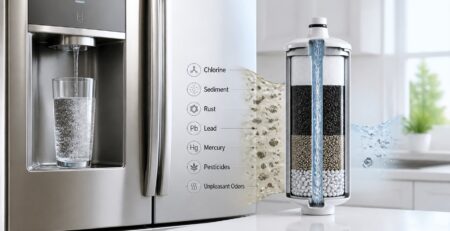
NSF/ANSI 42 covers aesthetic effects: chlorine taste and odor, plus particulate reduction and sediment reduction. It is the most common certification on refrigerator filters.
It also includes material safety. That part matters more than people realize, because it confirms the filter’s own plastics and media will not leach contaminants like arsenic or BPA into your water and ice.
Most third-party filters carry NSF/ANSI 42 and nothing else. If your city water is already treated and clean, that is often enough. Those filters are the cheapest option available. That changes if your utility report shows lead or your home has older pipes.
What NSF/ANSI 53 Covers For Health-Related Contaminants
NSF/ANSI 53 covers health-related contaminants. That list includes lead reduction, cysts like Giardia and Cryptosporidium, asbestos, mercury, and certain volatile organic compounds (VOCs).
One detail trips up a lot of shoppers: a filter does not have to meet every item on the NSF/ANSI 53 list to carry the certification. A cartridge may be certified for lead but not for cysts.
That is why reading the specific claims matters more than seeing the number 53 on a box. The Environmental Protection Agency maintains a tool for identifying filters certified to reduce lead to 5 parts per billion or less.
Certified compatible filters do reach this level. The everydrop EDR1RXD1 and its compatible equivalents are commonly certified under both NSF/ANSI 42 and 53. Some contaminants are newer than either standard, and they get tested under a different one.
When NSF/ANSI 401 Matters
NSF/ANSI 401 covers emerging contaminants: trace pharmaceuticals like ibuprofen, chemicals such as BPA and DEET, pesticides, and, in some cases, microplastics. Like standard 53, certification to 401 does not mean the filter handles every listed substance. Some 401-certified filters reduce trace chemicals but make no microplastics claim.
This standard is worth paying for if you live downstream from farmland, near heavy municipal discharge, or if you simply want the broadest coverage available. Premium models like the LG LT1000P and everydrop EDR2RXD1 often carry all three.
Chloramine reduction is a separate claim that some utilities make relevant. Check your annual water quality report before you decide. Knowing which standard you want is one thing. Confirming a listing is telling the truth is another.
How To Verify NSF Certification And WQA Approval
Three organizations test and list refrigerator filters: NSF, the Water Quality Association (WQA), and the International Association of Plumbing and Mechanical Officials (IAPMO). CSA Group certifies some plumbing products as well.
Each maintains a public, searchable listing database. You can look up a filter model number and see exactly which standards it holds and which contaminants it is certified to reduce.
Here is a quick verification routine:
- Find the filter model number, such as RFC0900A or EDR3RXD1
- Search the WQA product certification directory or the NSF listings for that number
- Confirm the standards listed match what the product page claims
- Check the specific contaminant claims, not just the standard number
- Be skeptical of a badge image with no listing behind it
A WQA Gold Seal and an ISO 9001 mark together tell you the product was tested and the factory follows a documented quality system.
Certification proves quality. It does not prove the cartridge will click into your fridge.
Match The Exact Part Number Before You Buy
Fit is not negotiable. Refrigerator water filters come in dozens of shapes, and one brand’s filter will not work in another brand’s housing.
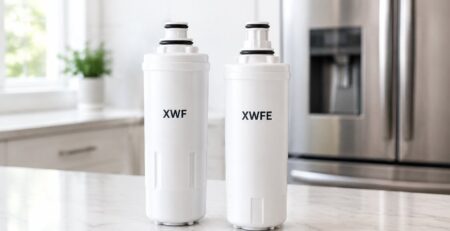
Even within a single brand, this gets confusing. GE Appliances alone makes six filter models: AFPWF, GSWF, MSWF, MWF, RPWFE, and XWFE. Each fits only certain refrigerators.
Find The Refrigerator Model Number Or Existing Filter Number
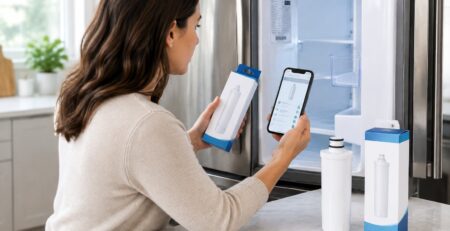
Pull the old filter out first. The model name or number is almost always printed on the label. That number is the fastest path to a match.
If the housing is empty or holds a bypass plug, find the refrigerator model number instead. Look at a nameplate inside the fresh food compartment. It is usually near a door edge or along the top wall.
Other places to check:
- The inside left wall of the fridge cavity
- Behind the crisper drawers
- The back of the unit near the power cord
- The owner’s manual or the appliance registration email
Write the number down exactly, including letters and dashes. A single wrong character sends you to the wrong cartridge family.
Once you have a number, the next move is to turn it into a confirmed replacement.
Confirm The Replacement Number And Filter Housing
Run your number through a cross-reference lookup. A refrigerator filter cross-reference tool maps an old part number to every compatible equivalent.
Then confirm the housing style. Twist-in cartridges mount in the upper right of the fresh food compartment. Push-in styles sit in a base grille slot. Some newer LG and Samsung models use an inline cartridge behind a door panel.
Photograph your old filter before you toss it. The photo settles any question about o-ring count, cap shape, or which direction the tabs face.
A few filter families cause more mix-ups than others.
Common Filter Families To Double-Check
These are the models most likely to be confused with a close cousin:
- everydrop EDR1RXD1 (formerly W10295370A and 4396701) fits many Whirlpool, Maytag, KitchenAid, and Kenmore side-by-side units
- EDR4RXD1 replaces the older 4396841 and 4396710 filters. Easy to confuse with EDR1RXD1
- EDR6D1 and EDR7D1 fit different base grille models and are not interchangeable
- UKF8001 and UKF7003 look similar but differ in length and thread
- GE MWF versus MSWF trips up owners of older GE units
- Samsung WF200 style cartridges vary by dispenser design
The everydrop Filter 1 EDR1RXD1 and its compatible versions are the single most cross-shopped family in this category. This is exactly why people order the wrong one.
For LG owners, the LG LT500P premium water filter carries part number 5231JA2002A. That number appears on both the cartridge and many older manuals.
With the right cartridge in hand, the installation is the easy part. Do the one step people skip.
Install, Flush, And Reset The New Filter
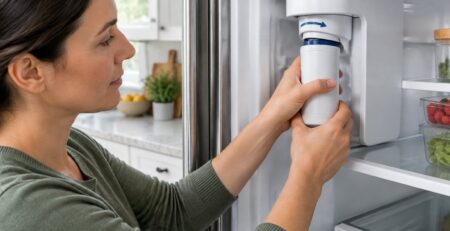
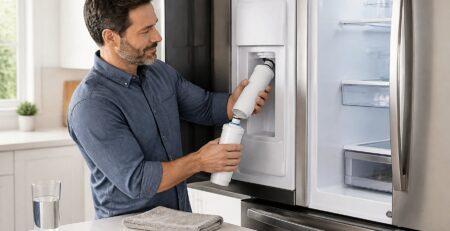
Turn the old filter counterclockwise about a quarter turn and pull it straight out. Some units drip a few ounces, so keep a towel underneath.
Push the new cartridge in and twist until it locks. Then flush at least 2 to 4 gallons through the dispenser, or roughly 3 to 5 minutes of running water.
Flushing clears loose carbon fines and trapped air. Skip it, and your first few glasses will look cloudy or taste faintly of carbon dust.
Last step: the filter reset. Hold the filter or water button on the control panel for 3 to 5 seconds until the indicator light turns from red to blue or green.
Fit confirmed. Certification verified. Price compared. A few things tip the final decision one way or the other.
Make A Confident Choice For Your Next Replacement
The deciding factor is certification plus verified fit, not the brand name on the label. Once those two boxes are checked, the choice becomes a budget question.
When A Certified Compatible Filter Is A Practical Choice
Pick a compatible filter when your water is municipally treated, your certification needs are covered, and you want to cut your annual cost roughly in half.
For most households on city water, an NSF/ANSI 42-certified cartridge handles chlorine taste and particulates well. Add NSF/ANSI 53 if your utility report or plumbing age flags lead.
The best aftermarket refrigerator water filter for your situation is usually the least expensive one that carries the exact certifications your water actually requires. Buying beyond that is spending on coverage you will not use.
Compatible filters also solve a problem that OEM cannot. Discontinued models. When the factory stops making a cartridge, a cross-referenced compatible version keeps an older fridge running.
There are still cases where the factory part wins outright.
When An OEM Filter Is The Better Fit
Choose OEM when your refrigerator uses chip-authenticated filters, when you need PFOS and PFOA reduction under NSF/ANSI P473, or when a service agreement makes it simplest.
Also, lean OEM if your model is brand new and compatible versions have not been fully validated yet. Give the aftermarket a year to catch up on housing tolerances.
Discounted OEM filters bridge this gap nicely. You can browse OEM Samsung refrigerator filters or factory LG filter options below big-box pricing without giving up the original part.
The real risk in this category is incompatible filters. It is fake.
Red Flags That Can Signal Counterfeit Or Unverified Filters
Counterfeit filters are a documented problem. U.S. Customs and Border Protection seizes thousands of fake cartridges periodically. Some have been found to add contaminants to water rather than remove them.
Watch for these warning signs:
- A brand-name filter priced at $8 to $12 when retail is $45
- Certification badges with no listing that you can verify in a public database
- Blurry printing, misspelled words, or a label that peels at the corner
- No model number on the cartridge itself, only on the box
- A seller with no return policy or contact information
- Packaging that copies the OEM logo but lists an unnamed manufacturer
Genuine compatible filters do not pretend to be OEM. IcePure and Polar print their own brand and their own model numbers. They list the OEM part they replace.
That distinction is your simplest protection. A filter that names what it replaces is being honest. A filter pretending to be the original is not.
The last step is getting from a part number on a sticker to a certified cartridge at your door.
Find A Certified Replacement With Model-Matching Support
Start with the part number you wrote down. Run it through a cross-reference lookup. Then compare the certified compatible option against the OEM version on price and standards.
If your number is worn off or your fridge is older, send it to a person. Model-matching support costs nothing and takes a few minutes.
You can browse the full refrigerator water filter catalog by brand. You can also check the top-rated refrigerator filters if you want the models that other homeowners reorder most.
Free shipping applies to every order. Multi-packs are available for the popular families like EDR1RXD1, UKF8001, and MWF.
Frequently Asked Questions
Are Compatible Refrigerator Water Filters as Safe and Effective as OEM Filters?
Certified compatible filters tested to NSF/ANSI 42 or NSF/ANSI 53 meet the same published performance standards as OEM cartridges. The certification, not the brand name, is the proof. Uncertified filters are a different story and should be avoided.
What NSF 42, NSF 53, or NSF 401 Certifications Should I Look For in a Replacement Refrigerator Water Filter?
NSF/ANSI 42 covers chlorine taste, odor, and particulates. It fits most homes on treated city water. NSF/ANSI 53 addresses health contaminants like lead and cysts. NSF/ANSI 401 covers trace pharmaceuticals and pesticides. Check your local water quality report to decide which one you need.
Will a Compatible Water Filter Fit My Whirlpool, Samsung, LG, or GE Refrigerator Correctly?
Yes, as long as the compatible filter lists your exact OEM part number, such as EDR1RXD1, LT1000P, or MWF. Fit is determined by the cartridge family, not the fridge brand. A few newer GE RPWFE models use chip authentication and may require the factory part.
Why Do OEM Refrigerator Water Filters Cost More Than Compatible Replacement Filters?
OEM pricing includes brand licensing, appliance-brand packaging, and retail distribution costs on top of manufacturing. Compatible makers skip those layers. This is how the Icepure RFC0600A lands about 40% under the GE MWF. The filtration media itself is often comparable.
Can an Off-Brand Refrigerator Water Filter Affect My Refrigerator Warranty or Water Dispenser Performance?
Under the Magnuson-Moss Warranty Act, a manufacturer generally cannot void your warranty simply for using an aftermarket part. Poorly built filters can cause slow flow or drips at the O-ring. This is why certified brands matter. Keep your receipt and certification details on file.
How Often Should I Replace an OEM or Compatible Refrigerator Water Filter?
Replace every six months or after 300 gallons, whichever comes first, for both OEM and compatible cartridges. Hard water or heavy sediment can shorten that window. If flow drops below about 16 ounces per minute, replace it early regardless of the calendar.
The Bottom Line on Your Next Filter Purchase
The OEM vs compatible refrigerator water filter decision is simpler than the price tags make it look. Confirm the exact part number, verify the NSF and WQA credentials, then buy whichever option meets those requirements for less.
For most homes on city water, a certified compatible filter delivers the same contaminant reduction for roughly 40% less than the factory version. For chip-verified models or PFAS reduction, the OEM part is worth the premium. Neither choice is wrong when certification backs it up.
If your part number is worn off or you are staring at two similar-looking cartridges, send the number to FilterForFridge.com and get a match at no cost. Certified filters start under $30, every order ships free, and optional six-month reminders mean you will not be doing this math again from scratch.