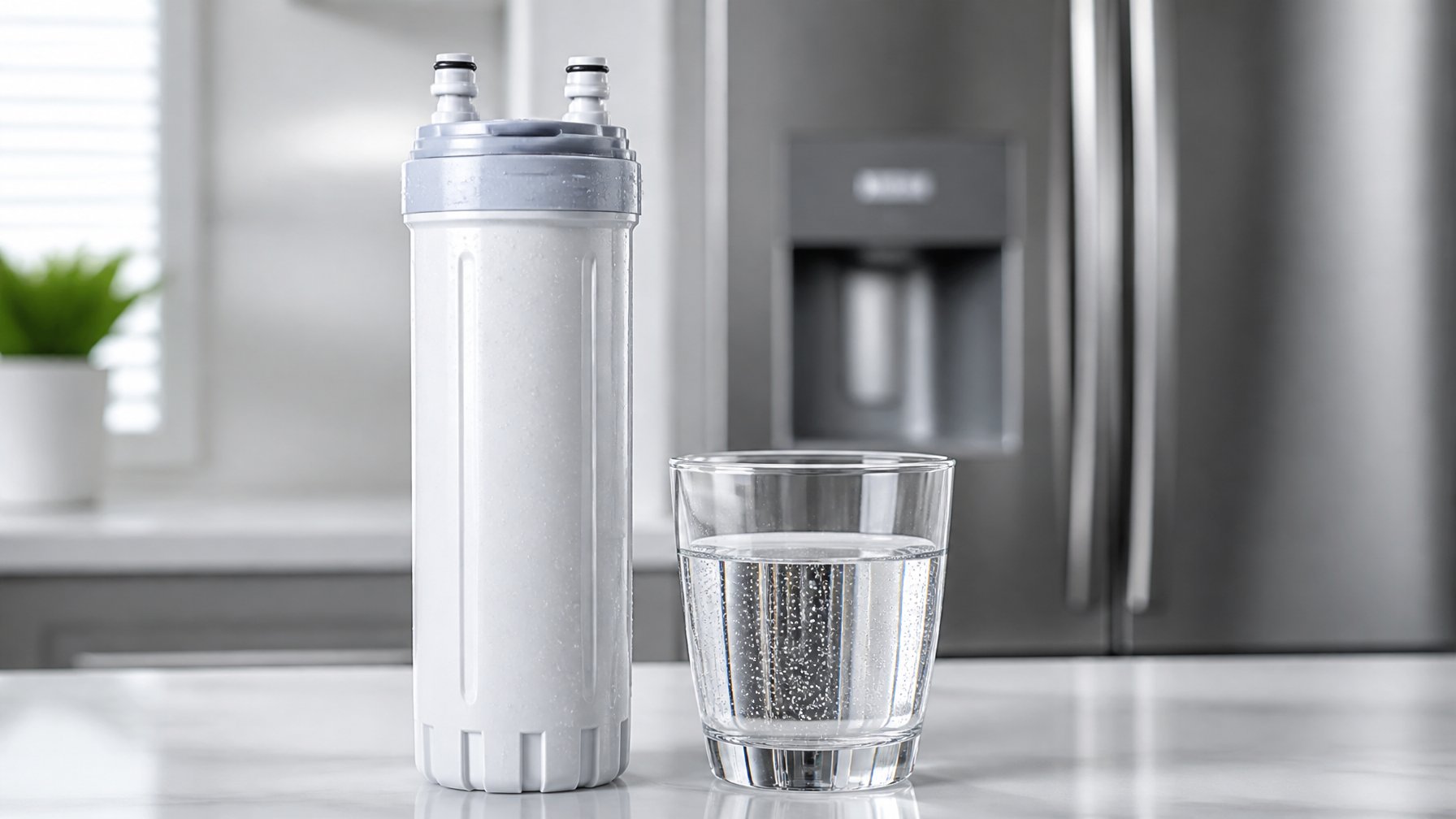
WQA-Approved Refrigerator Water Filter Explained: What the Seals Prove
You are staring at two product listings for the same fridge filter. One costs $52 and says OEM. The other costs $27, says compatible, and shows a small gold seal with the letters WQA. Your fridge does not care about branding. You do care whether the cheaper one actually cleans your water.
That gold seal is not decoration. The Water Quality Association (WQA) runs a testing program that checks whether a filter does what its package claims. NSF International certification does something similar under published standards. A filter that carries both has been tested by an outside lab, not just approved by the company that made it.
Knowing how to read those marks is the difference between guessing and buying with confidence.
Here is a WQA-approved refrigerator water filter explained in plain terms. You will learn what the approval verifies and how NSF/ANSI 42, 53, 401, and 372 differ. You will also see how to look up a filter in a public certification database and match a certification to your household’s actual water concern.
You have better things to do than research fridge parts. This guide keeps it practical and gets you back to your day.
What WQA Approval Actually Verifies
WQA approval means an independent lab tested the filter and confirmed it meets a published standard. It is not a marketing badge that a manufacturer can print on its own.
The Water Quality Association is a trade group for the water treatment industry, and its testing arm runs the Gold Seal certification program.
According to the WQA Gold Seal certification program, the program independently tests and certifies drinking water treatment units, system components, and other water treatment products. It tests them against NSF/ANSI and NSF/ANSI/CAN standards.
That matters because “certified” by itself means nothing without a standard behind it. WQA does not invent its own performance rules. It tests against the same industry standards NSF uses. It then issues the Gold Seal only to products that pass.
WQA-Approved Refrigerator Water Filter Explained: Reading the Label
The seal on a box tells you three things if you read it carefully: who certified the product, which standard it was tested against, and which claims were verified. A WQA-approved refrigerator water filter, explained in plain terms, is a filter that has passed lab testing for the specific reduction claims printed on its package.
Look for wording like “Tested and certified by WQA against NSF/ANSI Standard 42 for chlorine taste and odor reduction.” That sentence names the certifier, the standard, and the claim. A box that only says “certified quality” gives you none of that.
Compatible filters such as the Icepure RFC0600A, sold as an alternative to the GE MWF, and the Icepure RFC0900A or Polar PF8001, sold as alternatives to the Maytag UKF8001, list their reduction claims the same way an original manufacturer filter does. Read the claim line, not the brand name.
What WQA Gold Seal Certification Covers
Gold Seal testing looks at more than whether the filter takes chlorine out of your water. It checks the whole product.
- Contaminant reduction: the filter actually reduces what the label says it reduces, at the stated capacity
- Material safety: the plastics, carbon, and seals do not leach harmful substances into your drinking water
- Structural integrity: the housing holds up under household water pressure without cracking or leaking
- Accurate labeling: the performance data sheet matches the tested results
Structural integrity is the part most shoppers skip. A fridge filter sits under line pressure every hour of every day for six months. A house that fails floods your kitchen floor. No contaminant claim helps you then.
Material safety matters just as much. The filter body itself should not add anything to the water it is supposed to clean.
Why Annual Audits and Product Listings Matter
Certification is not a one-time test. Gold Seal certification includes ongoing surveillance. This means periodic plant audits and retesting of product pulled from the market.
That ongoing check is what stops a manufacturer from submitting a premium sample for testing and then producing something cheaper afterward. Without audits, a certification mark would only describe one batch from one week years ago.
WQA also maintains a public listing of certified products, searchable at the Gold Seal certified product database. If a filter claims WQA approval but does not appear in that listing under the company name and model, that is worth a question before you buy.
So WQA verifies against NSF/ANSI standards. This raises the obvious next question: what do those numbered standards actually test for?
How NSF and ANSI Standards Apply to Fridge Filters
NSF International writes the performance standards, and the American National Standards Institute (ANSI) approves them as national consensus standards. That is why you see them written as NSF/ANSI 42, NSF/ANSI 53, and so on.
Each number covers a different job. A filter can carry one standard, several, or none. The CDC’s guidance on choosing home water filters points shoppers to the NSF mark specifically because it tells you what a filter is verified to remove.
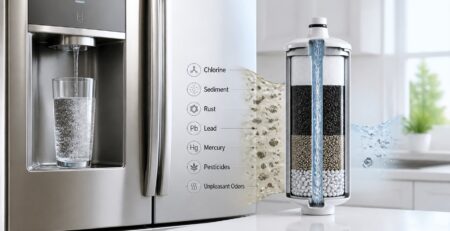
Most refrigerator filters use activated carbon, which is very good at some things and not designed for others. The standard tells you which is which.
NSF/ANSI 42 for Chlorine Taste, Odor, and Particulates
NSF/ANSI Standard 42 covers aesthetic effects: chlorine taste and odor, plus particulate reduction. It is about how your water tastes, smells, and looks.
This is the baseline standard for nearly every fridge filter on the market, including the everydrop EDR1RXD1 (also sold as W10295370A) for Whirlpool and Kenmore refrigerators. If your only complaint is that the ice tastes like a swimming pool, chlorine reduction under NSF/ANSI 42 is the claim that solves it.
Particulate reduction under Standard 42 is graded by class, based on the size of sediment the filter captures. A Class I rating covers the smallest particle range. That rating helps if you get occasional grit or cloudy water from municipal line work.
Standard 42 says nothing about health-related contaminants. That is a separate test.
NSF/ANSI 53 for Lead, Cysts, and VOCs
NSF/ANSI Standard 53 covers health effects. This is the standard that matters if you are worried about what is in your water, not just how it tastes.
Certification under Standard 53 can include claims for lead reduction, cyst reduction, volatile organic compounds (VOCs), asbestos, and certain heavy metals. Cyst reduction is the claim that covers Giardia and Cryptosporidium, two parasites that resist chlorine disinfection.
Here is the part shoppers miss: Standard 53 is claim-specific. A filter certified to NSF/ANSI 53 for cyst reduction is not automatically certified for lead reduction. The EPA’s consumer tool for identifying filters certified to reduce lead exists precisely because the mark alone does not tell you which claim applies.
Fridge filters certified under Standard 53 for lead, such as several models in the GE XWF and GE MSWF lines, print the claim on the performance data sheet inside the box. Read that sheet before you assume coverage.
NSF/ANSI 401 for Emerging Contaminants
NSF/ANSI Standard 401 covers what the industry calls emerging contaminants: substances found in trace amounts in drinking water supplies that are not yet federally regulated.
The tested list includes pharmaceuticals like ibuprofen and naproxen, along with bisphenol A (BPA), the insect repellent DEET, pesticides, and certain herbicides. These come from ordinary household and agricultural runoff that municipal treatment is not designed to fully remove.
Standard 401 is optional. Fewer refrigerator filters carry it. When a compatible filter lists NSF/ANSI 401 alongside 42 and 53, it has been tested for a longer contaminant list than a basic taste-and-odor filter.
NSF/ANSI 372 for Lead-Free Filter Materials
NSF/ANSI 372 is different from the others. It does not test what the filter removes. It tests what the filter is made of.
Standard 372 verifies that the product’s wetted surfaces meet the federal definition of lead-free, a weighted average of 0.25 percent lead or less. Every part of the water that touches on its way through the housing gets counted.
That is a materials standard, not a performance one. This is why you often see it listed alongside NSF/ANSI 42 rather than instead of it. A filter can reduce lead in water and still, in theory, be built from components that contain lead. Standard 372 closes that gap.
Four standards. Two certifying bodies. One small seal on a box. The next section compares how WQA and NSF marks stack up when you are choosing between two listings.
WQA Versus NSF Certification: What Shoppers Should Compare
Both WQA and NSF certify against the same NSF/ANSI standards. The difference is who ran the test, not how strict the test was.
NSF International writes the standards and also operates a certification body. WQA is a separate accredited certifier that tests products against those same published standards. A filter certified by WQA to NSF/ANSI 53 for lead reduction passed the same protocol as one certified by NSF International.
For a water filter certification comparison, the practical question is not which logo is better. It is whether the mark is tied to a named standard and a named claim.
Why a Certification Mark Needs a Specific Performance Claim
A logo without a standard number is close to meaningless. “NSF-certified water filter” on its own does not tell you what was tested.
Compare these two label lines:
- Vague: “NSF certified for quality and safety”
- Specific: “Tested and certified against NSF/ANSI 42 for chlorine taste and odor reduction and NSF/ANSI 53 for lead and cyst reduction”
The second line is verifiable. You can search the model number in a public database and confirm every claim. The first line cannot be checked at all.
Some listings also stretch the mark by certifying only one component of a system, then implying the whole product is certified. Ask which model number the certification applies to, and match it to the part number on the filter you are replacing.
How IAPMO and CSA Group Fit Into Water Filter Certification
WQA and NSF are not the only accredited certifiers in North America. Two others show up on the filter, packaging, and plumbing components.
IAPMO R&D, the research arm of the International Association of Plumbing and Mechanical Officials, certifies drinking water treatment units and plumbing components against NSF/ANSI standards. CSA Group does the same, and its mark is common on products sold in both the United States and Canada.
Seeing an IAPMO or CSA mark instead of WQA or NSF is not a downgrade. All four are accredited to test against the same standards. What you are checking is the same as always: which standard, which claim, which model number.
How to Verify a Filter Before You Buy
Verification takes about two minutes, and it is worth doing once for any new filter model you plan to reorder.
- Find the exact model number on the filter or the listing, such as EDR1RXD1, MWF, MSWF, XWF, UKF8001, or LT500P
- Search for that model number in the certifier’s public product listing
- Confirm the listed standard numbers match what the seller claims
- Check the claim wording, since NSF/ANSI 53 for cyst reduction is not the same as NSF/ANSI 53 for lead reduction
- Pull your annual Consumer Confidence Report from your water utility to see what is actually in your municipal water
That last step is the one most people skip. It changes everything about which certification you should care about. That points to the next decision: which standard your household actually needs.
Match the Certification to Your Household Water Concern
The right certification depends on what is in your water, not on which filter has the longest list of claims. Your water utility publishes a Consumer Confidence Report every year that tells you what it detected.
Read that report first. If your municipal supply shows no lead detections and the only issue is chlorine, paying extra for a filter with five certifications solves a problem you do not have.
Federal rules require utilities to meet safety standards for public tap water. The CDC’s overview of drinking water standards and regulations explains how that reporting works. Your filter should fill gaps, not duplicate treatment already happening upstream.
When Chlorine Taste and Odor Reduction May Be Enough
If your water tests clean and you just want better-tasting ice and drinking water, NSF/ANSI 42 does the job. That is what most granular activated carbon (GAC) and carbon block fridge filters are built for.
Carbon works by adsorption. Chlorine and the compounds that carry taste and odor stick to the carbon surface as water passes through. It is straightforward, effective, and inexpensive.
A compatible filter certified to NSF/ANSI 42, like the Polar PF8001 replacement for the Maytag UKF8001, handles this at a fraction of the OEM price. If taste is your only complaint, that is a sensible place to stop spending.
When to Look for Health-Related Contaminant Claims
Older plumbing, lead service lines, or a Consumer Confidence Report showing lead detections all point you toward NSF/ANSI 53 for lead reduction. Do not assume a carbon filter covers it.
Lead reduction usually requires a carbon block with an ion exchange component, not plain GAC. That is a design difference. It is why some filters carry the lead claim, and others do not.
Cyst reduction under NSF/ANSI 53 also matters if you have a household member with a weakened immune system. The CDC specifically flags Cryptosporidium as a risk for that group. Cyst-rated filters are the practical answer at the tap.
PFAS, PFOA, and PFOS Claims Require Closer Review
Per- and polyfluoroalkyl substances (PFAS), often called forever chemicals, are tested under NSF/ANSI 53 for PFOA and PFOS reduction. Very few refrigerator filters carry that claim. If a fridge filter listing advertises PFAS reduction, verify it in the certifier’s database against the specific model number.
General “reduces PFAS” language without a certified claim is not the same thing. Households with confirmed PFAS in their supply often need a different treatment approach entirely. This is the next honest limit worth naming.
When a Refrigerator Filter Is Not the Right Treatment Option
A fridge filter is a point-of-use carbon device. It is not built for every water problem. Pretending otherwise wastes money.
- Arsenic, nitrates, and total dissolved solids (TDS): these usually call for a reverse osmosis (RO) system certified to NSF/ANSI 58
- Hard water and scale: that is a softener issue, not a filter issue
- Untreated well or surface water: microbiological purification falls under NSF P231, not a fridge filter
- Ultraviolet disinfection needs: equipment that is certified to NSF/ANSI 55
If your Consumer Confidence Report or well test points to any of these, a fridge filter is a supplement, not a solution. For everything else, the filter in your door handles the job well.
Once you know which standard you need, the remaining task is making sure the certified filter you buy actually fits your refrigerator.
Choose a Compatible Replacement With Confidence
Fit comes down to the part number, not the brand on the fridge door. A certified filter that does not seat properly in the housing is useless, no matter how many standards it has passed. Start with the number printed on the filter you are pulling out. That is the most reliable identifier you have.
Confirm the Exact Refrigerator Filter Part Number
The part number is usually molded or printed on the filter cartridge itself. If the old filter is gone, check the inside of the fresh food compartment, the door manual sticker, or the owner’s manual.
Common part numbers by brand include:
- Whirlpool and Kenmore: EDR1RXD1, also listed as W10295370A and Filter 1
- GE: MWF, MSWF, and XWF
- Maytag: UKF8001
- LG: LT500P, also listed as 5231JA2002A
- Samsung: DA29-00020B, sold as the HAF-CIN
- Frigidaire: WF3CB and ULTRAWF
If you only have the refrigerator model number, a cross-reference filter tool will map it to the correct filter part. That is the fastest route from “I have no idea” to a confirmed match.
Compare OEM and Compatible Filter Claims, Not Just Price
Price gaps between OEM and compatible filters are real. The Icepure RFC0600A runs roughly 40 percent less than the original GE MWF. This adds up to two replacements a year.
But price is the second thing to compare. The first is the claim list. Put the OEM performance data sheet next to the compatible filter’s certification listing and check whether both cover the same standards.
If the OEM filter is certified to NSF/ANSI 42 and 53 and the compatible filter is certified to NSF/ANSI 42 only, that is a real difference in what you are getting. If both carry the same standards and claims, the price gap is just branding.
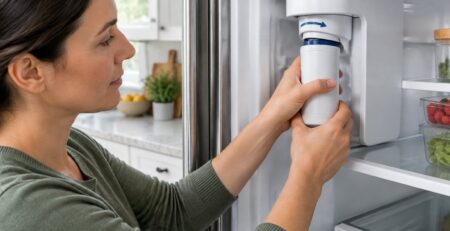
Replace the Filter Every Six Months or 300 Gallons
Certification capacity is tested to a rated volume. Most refrigerator filters are rated for 300 gallons. Manufacturers recommend replacement every six months, whichever comes first.
Past that point, the carbon is loaded, and the certified claims no longer apply. A filter that has stopped adsorbing chlorine does not warn you. Flow slows. Taste creeps back. By then,n you have been drinking unfiltered water for weeks.
If your household drinks a lot of filtered water, you may hit 300 gallons in six months. Households with a single occupant may not. The calendar reminder is the simpler guardrail for most people.
Check Flow Rate, Water Pressure, and Installation Fit
A certified filter still has to work with your fridge’s plumbing. Flow rate is measured in gallons per minute. A filter rated well below your fridge’s design flow will make the dispenser feel slow.
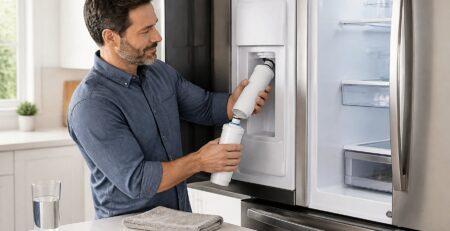
After installation, run about two to four gallons through the dispenser before drinking. That flushes carbon fines, the loose black specks that make the first glass look cloudy. It is normal, and it clears quickly.
Two more practical notes. If you are between filters, most refrigerators accept a bypass plug so water still flows unfiltered. If your model uses an inline filter behind the unit rather than a cartridge in the door, the part numbers and fit are different. Confirm the type before ordering.
Fit confirmed and certification verified. The last question is how to avoid overpaying in the next round.
Make Your Next Filter Replacement Simpler
Filter replacement is a twice-a-year task, so the goal is a repeatable routine that costs less each time. Certification knowledge is what makes that possible.
Once you know your part number and the standards you need, reordering takes two minutes.
Use Certification Details to Avoid Overpaying
The single most useful habit is comparing certification lists before comparing prices. When two filters carry identical NSF/ANSI 42 and NSF/ANSI 53 claims, the cheaper one is not a compromise.
That is where the savings live. A GE MWF replacement at big-box retail can run $50 or more. A certified compatible like the Icepure RFC0600A runs about 40 percent less for the same verified claims.
Buying in multi-packs cuts the per-unit cost further. It means the next replacement is already sitting in the pantry. Bulk savings on two, three, or four packs make the routine cheaper and remove the last-minute scramble.
Find a WQA-Approved and NSF-Certified Filter by Model Number
Search by the exact part number, not the fridge brand. EDR1RXD1, MWF, MSWF, XWF, UKF8001, LT500P, and DA29-00020B all pull up their matching options directly.
- The refrigerator water filter catalog at FilterForFridge.com is organized by model number for that reason, with both compatible and discounted OEM options listed side by side. Every order ships free.
- If your model number is not on the label anymore, or you are not sure which of two similar parts you need, email it in and get a match back. Optional six-month reminders keep the schedule on track without you tracking anything.
Two certifications, one part number, and a filter that costs less than the one you replaced. That is the whole system.
Stop Guessing at the Seal on the Box
WQA approval and NSF certification are not interchangeable logos. They are proof that an outside lab tested a filter against a named standard for a named claim. The testing did not stop after one batch.
The practical takeaway is short. Find your part number, confirm the standards you actually need based on your Consumer Confidence Report, and then buy the certified filter that costs less. Brand names do not filter water. Carbon, certified capacity, and a housing that holds pressure do.
Your next replacement is due in six months either way. Make it the cheap one. Email your model number to FilterForFridge.com and the team will match it for you at no cost, or call (615) 758-6915. Free shipping comes standard on every order.
Frequently Asked Questions
What Does WQA Approval Mean for a Refrigerator Water Filter?
It means the Water Quality Association tested the filter through its Gold Seal program and confirmed it meets a published NSF/ANSI standard. The testing covers contaminant reduction, material safety, and structural integrity. Certification also includes ongoing plant audits, not just a one-time test.
Is WQA Approval the Same as NSF Certification for Refrigerator Water Filters?
They are different certifying bodies testing against the same NSF/ANSI standards. NSF International writes the standards and certifies products. The Water Quality Association is a separate accredited certifier using those same protocols. What matters more than the logo is which standard number and which specific claim are listed.
How Can I Verify That a Replacement Refrigerator Water Filter Is WQA-Approved?
Find the exact model number, such as EDR1RXD1 or MWF. Search for it in the certifier’s public product listing. Confirm the listed standard numbers match what the seller advertises. If the model does not appear in the database under the manufacturer’s name, ask the seller before buying.
Which Contaminants Can a WQA-Approved Refrigerator Water Filter Reduce?
That depends entirely on the standards it was certified against. NSF/ANSI 42 covers chlorine taste, odor, and particulates. NSF/ANSI 53 covers health claims like lead, cysts, and volatile organic compounds. NSF/ANSI 401 covers emerging contaminants such as ibuprofen and DEET.
Do WQA-Approved Refrigerator Filters Also Meet NSF 42 or NSF 53 Standards?
Many do, but it is claim-specific rather than automatic. A filter certified to NSF/ANSI 42 for chlorine reduction is not automatically certified to NSF/ANSI 53 for lead reduction. Check the performance data sheet inside the box. It lists each verified claim separately.
Are WQA-Approved Compatible Refrigerator Water Filters Safe Alternatives to OEM Filters?
Yes, when the compatible filter carries the same standards and claims as the OEM version. A compatible model like the Icepure RFC0600A, sold as a GE MWF alternative, runs about 40 percent less for the same verified performance. Compare the certification lists side by side before comparing prices.